Tuesday, 30 October 2012

Five "Words" for the Poet

Your Word Resource: though this can be easily abused, it distinguishes one poet from the other. Do not allow "impression" to swallow up your "expression", or else you will find yourself abusing your words resource.

Word Picture: This is a mainstay of any poetry. They are made manifest not in overlaboured lines but in simple lines with so much profundity.

Word Music: Words are not empty. They are musical. Pay attention to the musicality in your words. We have varieties of figures of speech that enhance musicality; make use of them.

Word Site: Every word creates its own kind of ambience, its own atmosphere. Words go a long way in telling the readers the type of poem you write or what you aim at doing with words.

Word Soul/ Spirit: This is more like the persona of the poem, who feels, eats, drinks, etc. What do we eat? What do we drink? These are the questions you answer in creating a persona, in breathing soul to your poem. Remember everyone wants to go to somebody who has life in him or her, so once your work lacks soul or spirit, people avoid them.

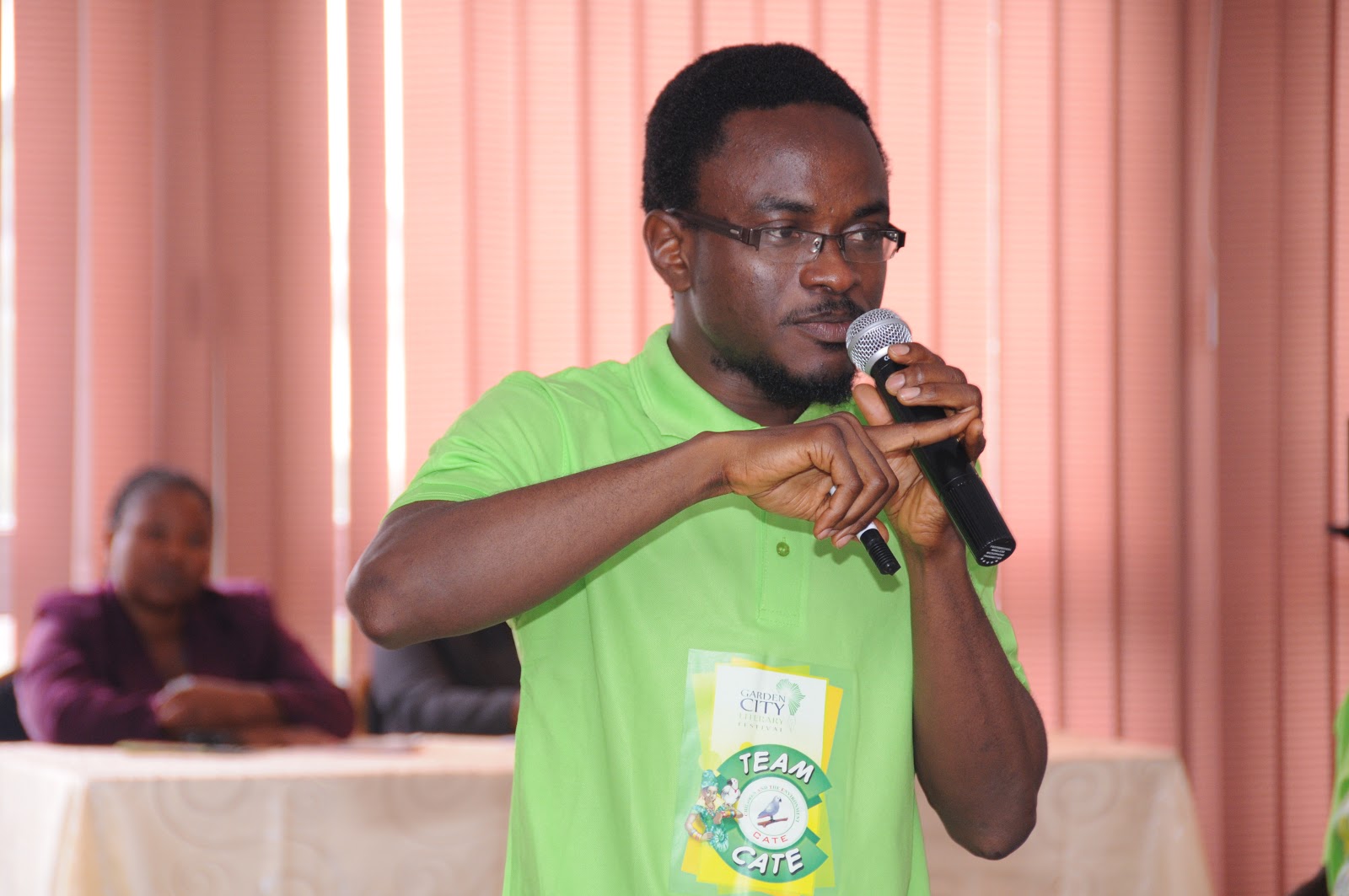
***Being Lessons from the poetry workshop that held at the GCLF. It was facilitated by Dr. Obari Gomba. 

Monday, 29 October 2012

Emmanuel Okoh: My GCLF Experience


Emmanuel Uweru Okoh's works have been published in NEXT, Saraba magazine, Sentinel Nigeria, Naijastories.com, ITCH magazine and Mad Hatters’ Review of Iceland. Emmanuel lives and works in Lagos, Nigeria. His poetry collection, Gardens and Caves, will be published by SunBird Books, November 2012. Emmanuel was at the Garden City Literary Festival, 2012; he writes about his experience. 

My second application to be a part of the Garden City Literary Festival, a gathering of book heads and the likes in its fifth year clicked. I got an email first. I was excited, but still wasn't sure. So, I took the first step towards being sure by sending a confirmation SMS as requested by the organizers. And on the 14th of October, I made my trip to Port Harcourt. 

The literary festival which took place between 15th and 20th October 2012, at the Hotel Presidential, Port Harcourt held a creative array of events: exhibitions, seminars, book readings, essay competitions, a Jazz/Poetry evening and a writers’ workshop. 

I was in the poetry workshop class.  Ours was a gathering of green and published poets with Dr. Obari Gomba as the facilitator, an interesting and fine man who at the first poetry class opened our eyes to some new ways to approach poetry. Lessons were woven around the special nature of poetry and how as writers, we must abide by some ground rules to achieve a masterpiece each time we set to write a poem.

He likened the ground rules to the 30 commandments of poetry. Ours was a practical one, and at the end of the class we wrote our first poems for the workshop which we exchanged among ourselves for improvement. 

Our next class was on imagery through sight, touch and smell. We engaged in writing short lines that reflected strong imagery, for this played a major role in good poetry. Closing the day, we had a task of producing two poems on any subject. So I went to work; my laptop and I. No noise. It was my usual romance with solitude that bore the poems that I have published for my reading audience so far.

Here is a poem for the workshop:

SARO WIWA’S CALL (for Ken Saro Wiwa)
My keen cry to Kenule:
 I, Fubara, of torn fishnet and gaping boat,
Of gasping fish and de-flowered flowers.
I sit on a lonely log; one of the few remaining.
I write on a Dutchman’s Dollar paper
It left the howling helicopter 
Black crude; my ink, my thin thighs; my table
Hear my call Kenule, for your ears know truth. 

Your ink bullets still hover in mid-mission,
Taking rests on shrunken leaves and greased waters
Cruel antics of the goggled General regenerates
 In bloody resonance- Where lies our hope?
We await the revolution of fish and oysters
From long years of petrol-logged breath
And bone splinters from Shell’s shell.  
Let the cry of prawns aid my call to you, Kenule

Caked soot sit on my nasal paths. 
I breathe with my ears; ears saturated with news of
Inverted justice, of blood soaked loot I loathe. 
Hear these words Kenule. And berth those 
Ink bullets of fourth estate fame and stencil 
Romance. That short romance of eternal frenzy
That die not from ‘feeble’ minds of Generals
Nor fumes from the Dutch industrial farts. 


Friday, 26 October 2012

Doreen Baingana in Conversation with Igoni Barrett

Igoni Barrett, author of From Caves of Rotten Teeth,  introduced Doreen Baingana, two-time shortlisted author for the Caine Prize for African writing. After this, Doreen read from her collection of interlinked short stories Tropical Fish: Stories out of Entebbe. We meet a girl who through her words, transformed into a woman; she was exploring her parents' room, and at the same time, the world.

Barrett dived into the conversation, asking interesting questions, raising interesting issues, rousing some dust. How should writing--if it does--address women's issues? How does her work Tropical Fish achieve this? For Baingana, "writing should first of all, it's about entertainment, enjoying words, and language. Also, the story is about the exploration of being human, of a young girl transforming into a woman. For her, it's all a game of adolescence. It helps us understand what makes us men, what makes us women and it helps us address these issues."

The African publishing sector is undergoing changes. However, Barrett wanted to know if female writers face any particular challenges that their male counterparts do not experience when it comes to publishing? Baingana thinks the challenges that face African publishing are not gender selective however "there are challenges that we face as female writers. The challenge for me now is that I have a four-year-old child. Writing is something that takes a lot of time, mental space but raising a family also takes a lot of time."  She equally considers being a writer, being a female writer in Africa a privilege "Just to become a writer is a privilege; it has to do with the kind of education that you got, that you had access to proper health care. You don't become a writer out of the blues but it is because of how you were brought up, a sum of your experiences. There are challenges that women face when it comes to education." (Find out stats about female education in Africa). Doreen Baingana studied Law at the Makerere University, Kampala and has an MFA from the University of Maryland, after which she returned to Uganda, where she still lives. 

Baingana also talked about women writers and self-censorship. The society does not think that women writers should be sexually explicit, not in reality, definitely not in writing. She says "You may not realise how much you are self-censored. There are some of my stories that are sexually explicit however there are women who do not write such because they self-censor." 


Barrett also wanted to know if there are any such things as women issues. If there are, how does Baingana's writing address them as a female writer? In response, Baingana delves into the world of publishing and its tags for female writing "I think that publishers take female writers as writing about women issues but they take male writers as writing about human issues. So many men get published because of that and there are many women who could have gotten big but are not."

Baingana accepted that she addresses issues pertaining to women in her writing. She made a case for her choice "I think it is about being marginalised, silenced, then you have to make a bigger push to be seen. We have to portray reality. Women are a complexity of characterisations and fiction should show that. Right now, I prefer seeing through female characters. We should be free to write whatever we want."

Baingana is known for her fiction for which she has won awards. However, Barrett made the audience know that she once tried her hands on poetry. She had this to say about her poetry which she called "unpublishable" "I used to write poetry, I still do; for me, poetry is just an emotional outlet. I am still very interested in poetry, and in language though I am better with fiction. So, I sneak poetry into my fiction sometimes." 

What role does art play in the society, if it plays any? Baingana made a case for arts. "My initial belief is that art can be valued even as a beautiful thing. However art can help in social development. As writers, we learn to express ourselves about how to be in this world. Art helps us reflect on the realities in the society; look at what art did with apartheid in South Africa. Art can also help with female emancipation. There is also the catharsis too that you feel when art makes you feel better."

Baingana was asked to describe Nigeria, to a Ugandan friend; she had this to say "I fear generalisations. If you write about it, then you can be specific. The diversities her are remarkable. When you go to a different place, you see things starkly: how do you eat hot suya in really hot weather? There is a lot of energy here, a country full of energetic people. I think Nigeria should work more on its public relations because we hear more of the negativity."

The floor was opened to the audience who asked a variety of questions: what should be the impact of writing? What advice do you have for budding writers on publishing? How should women writers deal with motherhood, housework and writing?  To the last question, she responded in a funny way "then they have to stop doing housework." Then more seriously, she continued "Most women do not have a sense of self. It is very important for women to create time for themselves. There is the whole issue of work-life balance and it's in finding what's comfortable. It's about the choices that you make in your life.  It's unfortunate that people think that you are a "good woman" yet you do not have time to write. What does it mean to be a writer to you? What does it mean being a woman? If you need to write and deal with the household, then hire a maid." She concluded, the audience laughed as they clapped and proceeded to the back of the hall for Baingana's autograph. 

Thursday, 25 October 2012

The Voice Diary: October 20, 2012

The orchestra of the Rivers State Public Primary Schools opened the event with the National Anthem; then the followed with a rendition of "Ijoba Orun." During the children session, everyone is Aunty and Uncle, well, that's what the children understand better. 

Aunty Koko apologised that the event started late. "You are a very important part of what we are doing and we take a section of the festival that concerns you very importantly. I was a child like you in this city. I've sat where you've sit in this city, that's why I have a heart for the section of our work that involves children, that's why we bring role models to read to you. We bring the Governor also once a year to read to you. I hope you enjoy this session," she said welcoming the children to the event.  

Children were asked about their experience during the festival; they had interesting things to say. Chidera, 9, said "The workshop I attended was the creative workshop, and I learnt that I should read books. I read the Wicked Old Woman." I learnt that it was good to give to one another." Daniel Mattias, also 9 said, "I leant how to paint and draw."

Polly Alakija, one of the facilitators of the creative workshops read from the People Who Make Our History Series: Herbert Macaulay. The students asked questions and also shared their lessons from the book with the audience. After this, there was a Question and Answer session with Aunty Polly. 

On her experience with the children, she said "It was great fun, it was quite tiring. We had great fun. I had two days with each group. It normally takes at least a year to get a book together, the actual putting the book together and our challenge was to put the story together in two days."

Alakija's love for illustration started as a young child. She said "I knew a lot of illustrators, painters as a child. To me a book is like a box of magic, it is the same reason I love painting and film because you never know what you will find." 

Prizes were awarded to the children who won the Essay Competition for 2012. "They win a grant to support their education, books to build their personal libraries," said Kalango. The Governor of Rivers State, Governor Rotimi Amaechi presented certificates to the winners. The winners, Echikunwoke Chinasa Kenneth, Ogunkale Oluwatamilore, Ubah Chidinma Vivian beamed to the camera as they shook hands with the Governor. 

The Governor emphasised the importance of education and informed the audience on the programmes that the state is working on. "Education is key to us and it is important that you take education seriously. We are trying to take our government schools to a greater standard. The teachers will have the minimum qualification of NCE. All primary schools must have ICT, all including the ones that belong to the Rivers State Government. We are trying to renovate our schools, to furnish them. We are sending a bill to the House that it is a crime not to send your child to school. If you do not send your child to school, you will go to prison for a minimum of three months. We will not collect fees, just send your children to school. I have leaked to you the secrets of government and we are working towards achieving these objectives... I congratulate you all for coming, you all look exciting and energetic. I wish all of you the best of luck," he said. 

There was a performance of a play by the children. The play focused on the only Queen that ever was in the Niger Delta area, Queen Kambassa. The children made use of songs and dance,  to emphasise the theme of the play which matched the theme for the festival: Women and Literature. 

The Rivers State Sustainable Development Agency, the official sponsors of the Children Event also gave their speech. They presented books to the children throughout the festival. The agency is aimed at driving development in Rivers state. 

The children all went home, smiling, with gift bags with books to build their personal libraries. 

The evening was the poetry feast with poetry performances from different poets, established and upcoming. Biokpo West was an highlight; he rendered the poem "Noah's Ark" in pidgin which got the audience pondering yet laughing. We will publish the poem on the blog in the coming days.

Pa Gabriel Okara who was the special guest at the event addressed the young writers. "This is pleasing and encouraging, and makes me think that Nigeria has a future. We are lucky to have somebody like Mrs Kalango here, who would make this possible with her creative thinking, imagination. We are now breeding a crop of young men and women in the art of creative writing, which means a crop of young men and women who will speak the truth at all time without fear. She is nurturing a nucleus of thoughts combined," he said.

Koko Kalango thanked everyone who was part of the event, and officially brought the Garden City Literary Festival 2012 to a close. She said "We thank all of you who are here, for every visitor, participant who has been a part of what we are doing...you are the reason why this is holding."


Saturday, 20 October 2012

Creative Workshops with Polly Alakija

Today, the children will show the whole world what they have been working on, all week long: paintings, performances and dances. Are you ready? Here are pictures from the different workshops. The venue is the Main Banquet Hall, Hotel Presidential. Time is 1pm. 

Children at work with Polly Alakija

I can paint!

We love listening!

All eyes on the teacher

Watch me as I do this!


Still in the works

In the works

See our inventions


Creative Workshops with CATE

There was yet another group of children handled by Sola Alamutu of the organisation, Children and the Environment (CATE). The children had fun all week long, learnt new ways of clapping, and telling stories. 


Friday, 19 October 2012

The Voice Diary: October 19, 2012


The day started with budding writers--the Elechi Amadi master class for fiction writers. Most of the students were from the fiction class. The author of acclaimed novel The Concubine, took the students on the major tools of fiction. The tools, which he calls the "standard tools which help them achieve success" include: realism, suspense, humour and entertainment, irony, flashback and stream of consciousness. 

He encouraged the budding writers to read widely, because in reading, they will learn about various writing styles and have a better understanding of the world "By reading, you pick up the language and general knowledge of the world. It also helps you to uphold the morals of the society. it gives us an idea of history. Some novels carry the elements of history. That's why the novels cannot die. The novel lives on; it is very concentrated entertainment."

He also talked about criticism and how writers should react to it "Criticism is good...but you can have some criticism that can make an author hopeless. There are also some that can elevate the spirit. Once you write a novel, it becomes world property. Anybody can criticise it and write what they want about it. Just remain calm. Don't start writing back. One, you will be distracted, and won't have time to do more work. Just note the points that they have made. For everyone who says your book is bad, there is almost an equal number saying it is good.  You may be lucky to find other people supporting you. Note the good points for your other works. You can have a chance to reply when you have interactions with your readers. Don't just write an article in response. You are wasting your time." 

He implored the writers to be realistic in their writing, even when they are trying to criticise the society. "I told my story in the way I knew how and showed our society at work. I didn't go out to showcase our traditional behaviours, etc. Just tell your story and uphold the morals. Just describe the society as you see it and in your own way uphold the morals, tell the story and in your way, the rest will come. Write the best way you can."

Some minutes after the master class, the students went for the poetry and prose classes respectively. There, they were presented with the certificates for participation which bore their names. The fiction class also featured Chibundu Onuzo who worked with Doreen Baingana in teaching the students more on fiction. The poetry class focused on self-criticism and publishing.

The evening was time for the seminar on women and love in literature. The panelists were:  Sophia Obi-Apoko, author, Tears in a Basket; Professor Julia Okoh, the Director of the Arts Village; Professor Charles Nnolim, retired lecturer and Dr. Julie Umukoro, the Head of Department, Theatre Arts. The event was moderated by Eze Ibekwe, a lecturer at the University of Port Harcourt. 

Some of the questions that were raised included: do women have a place in literature? How are women portrayed in literature? If there is a femme fatale, why is there no homme fatale? What do women writers write about love? How do they portray polygamy? How does African literature portray love? 

Dr Julie Okoro on polygamy: I have always looked at issues from a global perspective. Monogamy is the influence of the developed world with colonialism and all that. At this point in time we should be talking about African ideologies which we should uphold about Africa. Polygamy is an African way of life; it was practised from the beginning of time and there were codes of conduct attached with it. And then came Christianity which came to dilute our own practices and came with monogamy. Let us look at how practicable this is. Let us look at the days of our forefathers I saw ethics. With polygamy, there was love, control over the women. There are codes of conduct that if betrayal comes, there were sanctions. Treatments were meted out equally and when there was partiality, three were punishments that went with it. We are not practising monogamy; some men have one wife and have many concubines outside. Women are more than men and look at monogamy, you are encouraging most women to become old maids. We should ask ourselves; how did our forefathers practise polygamy? There is no use practising half and half because we are neither here nor there. We do not have what we call an African ideology that we are selling to our youth. If it is properly marshaled with dos and don'ts, it may work.

Sophia Obi said that polygamy is a result of the patriarchal structure of the society. "There is no way we talk about love that jealousy will not come in. All these issues accumulated are issues that make the woman someone that's seen as  a deviant if she wants to protest about issues that deal with her feelings. Who made the African laws? Why are we so adherent to them even when the women are crying out? We cannot remain in the circle to say that our forefathers handed these issues to us, even if they had rules, were the rules okay with the women? How did they feel about these issues? It was not okay then, definitely it won't be okay now where most of the women are educated. Most of the women are even bread winners, so they even have limited time to care for themselves and their families. We need to address the issues causing these problems; they are family issues and if they are not addressed, they will cause problems to the society at large."

Professor Charles Nnolim was the "accomodationist", the one whose position handles both of them. "In America, they are talking about bigamy; it is progressive polygamy. Africans think that women are inferiorised. Until men in Africa begin to look at women as equals, this debate will continue. Women are also clever when they talk about love outside marriage, there are many women who practise it. You say that variety is the beauty of life. There should be love and unity within a family. If you have polygamy, let there be love. If you marry a wife, you should be able to accept everything that comes with her. We should be going towards accommodation."

The debate was followed by a Question and Answer session which the panelists were ready for. There were questions about love, literature, women, the materialistic nature of love today, among others. Professor Julia Okoh ended the session by advocating for more love in the society " People should try to love one another; if man and woman love each other, this world will be better."


The last event for the day was a Meet-the-Author session with Chibundu Onuzo; it was moderated by Daniella Menezor of the Rainbow Book Club. She responded to questions about her writing, her new book and handling success as a young writer. Questions were taken from the audience, and Chibundu signed copies of her books for members of the audience.