
Monday, 9 July 2012
2012 Wole Soyinka Prize for Literature: Long List

Sunday, 8 July 2012
Myne Whitman: Beyond Writing

The decision to self-publish my first book, A Heart to Mend, arose naturally from sharing excerpts of it on my blog. Subscribers loved the story, connected with the characters, and offered genuine feedback. They wanted more, and so I gave them the complete book. Some critics of self-publishing for profit have said that I could have provided a freely downloadable document, but by then, I had so many ideas that went beyond writing, and since I am a big believer in sustainability, I wanted these plans to pay their own way.
The blog itself was an idea mooted at the writer’s group I belonged to at the time, and though I wasn’t new to websites and online forums, I had never considered a blog as a means of sharing my writing. At the beginning, the blog had the subtitle of “my journey to print”, and I did not know then that I would self-publish. I was editing the manuscript, which though complete was still in drafts, according the guidelines of the publishers I hoped would publish it. I pursued traditional publication of that manuscript, A Heart to Mend, for about six months before choosing to self-publish.
I had gotten some rejections along the way that made it clear my writing did not fit the mould of any particular genre. From some editors, there were more details of the kind of changes I might have to make to get traditionally published, but I couldn’t see myself making some of those changes. So I did the necessary research into self-publishing and decided to go ahead. By choosing self-publishing instead of tailoring my writings to fit a pattern specified by traditional publishers, I knew I was making a choice to go beyond my personal goals.
True, I wanted my writing to remain undiluted - and this is in no way a dig at other Nigerian authors traditionally published in the West – but I also saw an opportunity to realise other dreams, like being a sort of mentor to like-minded writers. However, this was not totally altruistic. As a publisher, I had to acknowledge the poor reading and book-buying culture among those who identified with my stories – mostly Nigerians - and I knew that if my book was to be read as widely as I wanted, I would personally have to be part of building up such readers and book buyers.
A Heart to Mend was published in December 2009 in the United States, and released to good reviews in Nigeria in March 2010. When I won the Nigerian Blog Awards, my visibility increased exponentially among online Nigerians. Followership of my blog, Facebook and Twitter platform climbed to over 3,000 people, and I guessed it was time to put some of my earlier ideas into action. From my experience of blogging, publishing and promoting AHTM, I knew that it was essential to have an online space where the community I planned would feel comfortable.
This idea of an online space was validated by a collaborative fiction web-series I had successfully hosted on my blog. There were also the myriad of emails and Facebook messages I received in the wake of releasing AHTM. A lot of such emails were from aspiring Nigerian writers who wanted me to critique their writings, or act as their agents to traditional publishers in the United States. Some wanted me to publish them or help them find agents and/or publishers. I realized that a lot of them were quite talented, but unaware of the required processes in getting published.

That was how NaijaStories.com; launched in April 2010 as the premier community for those who read, write, or love Nigerian writing. I had found there were no social networks that promoted Nigerian books even as more and more Nigerians were using social media. NaijaStories.com showcases Nigerian writing, and combines elements of a writing critique website as well as a social networking site. This makes it versatile, allowing the writers to offer criticism of each other's work as well as attracting those who are interested in reading our kind of stories.
Through the website, now with over 2000 members, we hope to build an army of people who will read and buy Nigerian books. It is also act as a central point where a global audience can read in one place, authentic stories written by Nigerians and about Nigerians. Recently, we have begun to attract traditional publishers and agents seeking writing talent or wanting to promote their books, and we also support writers who wish to self-publish. One of our goals is to establish a publishing company and release select works as anthologies and also commission full-length novels.

Friday, 6 July 2012
A Harvest with Wole Soyinka

Every Sunday in July, there will be performances of plays written by Wole Soyinka at Terrakulture. Click on poster for more details.
Thursday, 5 July 2012
“The Past is Always Better Than the Present”
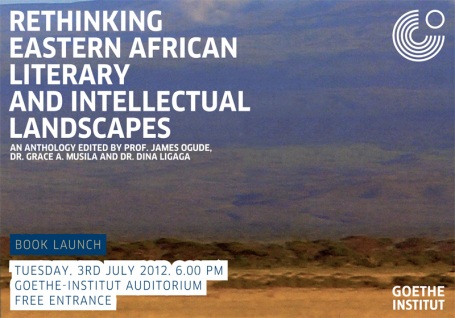
Rethinking Eastern African Literary and Intellectual Landscapes is a new book, a collaborative effort between East African academics, writers and thinkers. The book launched at the Goethe Institut in Nairobi on the 3rd of July, 2012.
While introducing the book, Dr. Tom Odhiambo reaffirmed the urgency and need of such endeavours by East African thinkers. He lamented the baleful disregard of arts and humanities by university administrations in Kenya where it frequently occurs that academics are unable to secure funding for their projects ‘because their work is not scientific enough’.
Dr. James Ogude explained how the book was conceptualized; it is an attempt at finding ways to re-energising intellectual scholarships within East Africa.
“We may work with the world, but it is necessary to have our own local interventions,” Ogude said. “A society that relies on foreign voices to tell its own stories is a dying society.”
Ogude recounted the intellectual climate of the 60s. “We have never looked back at that era and captured the intellectual traditions,” he said and illustrated how Ngugi and others led the intellectual revolution. “This book attempts to reassert East Africa as an important site of culture and intellectualism.”
Ogude shared details of his recent meeting with Ngugi. “Ngugi and I reminisced on those days gone. See, back then, we never quite realized the contribution of scholars in the region. And then Ngugi asked me where in Nairobi the book was to launch. He laughed when I told him, said we are still relying on the patronage of former colonial masters. What happened to our own homegrown spaces? Why do we never take the initiative?”
Ogude explained how received theories (from the west) inflected the manner of perception of our own experiences by reversing the hierarchy of our intellectual values. This is what Ogude terms as ‘The African Urgency’, one that needs to be addressed.
“The humanities are the crucible of society. We can produce technocrats, but society needs its thinkers.”
Dr. Godwin Murunga criticised the learning of African Studies as a distinct, monolithic unit. “I do not understand why, in this day and age, a university in Africa would teach African Studies. Have we, all this time, been studying aliens?” he asked. “Why must we depart from history, from literature, from art, and look for Africa in a place called ‘Africa Studies’?”
Murunga spoke of the global politics of education and the bearing of one’s academic affiliations to one’s global visibility (a severe reality that makes African scholars virtually invisible). He also spoke of the pitiful internal dynamics of our own institutions, the astonishing ways in which our universities self-annihilate.
Dr. George Ogola discussed the politics of the exiled African intellectual. He explained that diasporic intellectuals are often dismissed as inauthentic precisely because of their absence, a criticism that ignores the moral and material realities. Intellectual traditions do not follow linear trajectories, and many intellectuals and thinkers are so because of the anxieties of exile.
Ogola explained that the book is important due to its decolonisation of modernities, and due to the fact that the book not only focuses on Kenya or Africa but transcends it.
“This book is both historical and contemporary,” he said. “It redresses concerns of thematic insularities. It questions, for example, not just the patriarchy of European imperialism, but of African nationalism. What is the place of the woman as producer of intelligent output? Whose intelligent traditions are we engaging with, and where is the place of the woman in this?”
After a brief musical interlude during which the gripping Makadem performed, the audience was allowed to field questions. One particularly resonating one came from someone that spoke heatedly of what he termed as ‘positive primitivism’.
“The past is always better than the present,” he said, levelling his criticism against the intellectuals who looked back at the 60s and 70s through rose-tinted spectacles. “The revolution of the 70s meant to bring African voices at the centre of departments, and to put English aside. What then would have been the logical conclusion?”
He explained that in his opinion, African voices are best heard in African languages. In Kenya, there is a larger body of work in Swahili today than there was in English in all of the 60s, 70s and 80s combined.
“Why then do we say that literature has died? Back then, we were unhappy about expressing Kenyan voices in foreign languages. What we hear now is a dominant story, one expressed in English. Does it mean that if it a voice does not speak in English then it does not exist?”
In answer to this, Ogude expressed satisfaction at the growing body of work in Swahili and other local languages. He warned, however, that it will come to naught should this work be ignored by intellectuals.
“We need to engage with these works,” he said. He went on to address the criticism against such ‘positive primitivism’ with regards to the nostalgia of the 60s and 70s:
“Makerere, the University of Nairobi were functional institutions back then. We need not sweep realities under carpets. We must face ourselves, demand answers from ourselves. It is inevitable that intellectualism will plummet if student bodies increase exponentially without concomitant increase in academic resources. What we are seeing right now is a phenomenon where our students do not go through university, but university goes through our students!”
Tuesday, 3 July 2012
Governor Rotimi Amaechi Celebrates with Children

In what has become a Children’s Day tradition, the Governor of Rivers State Chibiuke Rotimi Amaechi, read to children at the State School Mgbuitanwo, in Emouha Local Government Area. The Governor, whose birthday falls on the same day as Children’s Day, read to the children from Gabriel Okara’s book Little Snake and Little Frog which narrates the friendship between the little Snake and the Little Frog and how this is shattered by their parents’ revelations of its deceptive nature.
After the reading, the children treated the Governor to a wonderful reception in their assembly hall. There they sang and danced and gave him a birthday present. Governor Amaechi who appeared to thoroughly enjoy himself, thanked the children, the Rainbow book club and the Ministry of Education for the enriching experience.
Mrs Koko Kalango, founder of the Rainbow Book Club, the organisers of the ‘Rivers State Reads’ campaign and, the anchor of the session asked the children what they thought of the story. The children, many not more than 10 years, were quick with their responses. Impressed by their confidence and boldness, the governor too shared his understanding of the story with them. He said it was a story about conflict and survival which was not necessarily a bad thing. He pointed out, for instance, that the snake needs to eat to survive just like the frog wouldn’t play with food if it were hungry. Mrs Kalango, who agreed with the Governor went on to give another interpretation saying that fear, as seen in the mother frog, instigates conflict while faith and love promote peace.
In a brief interactive session that followed the reading, the children once again amazed the governor and dignitaries present by their insightful questions; ‘Did you ever dream of being a governor?’, ‘Do you like being a governor?’ ‘Why did you decide to celebrate your birthday with us?’ In his characteristic disarming way, Amaechi told the children that he decided to become Governor in 2002 because he felt he had something to contribute to the state. He added that though it was good to be a governor, there were also challenges. He narrated to the children how he rose from a humble background to become governor and challenged the children to aspire to greater heights especially as his administration has renovated schools, created a conducive environment for them to learn in.
The event ended with the donation of 300 bags of books to the children by the governor. The reading was also attended by the Hon. Commissioner Education Dame Alice Lawrence.
Report by Daniella Menezor, Member, Rainbow Book Club.
The event ended with the donation of 300 bags of books to the children by the governor. The reading was also attended by the Hon. Commissioner Education Dame Alice Lawrence.
Report by Daniella Menezor, Member, Rainbow Book Club.
Sunday, 1 July 2012
Emmanuel Iduma: The Parameters of Longing
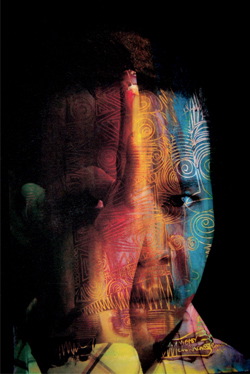 |
| Art by Victor Ehikhamenor |
Suppose we call this ‘neo-literariness’, for want of a better word, and because in hyphenation a word acquires two identities. So, neo-literariness is the word to use for a generation of writers and enthusiasts who function despite institutional lapses, and whose artistic engagement thrives of new ways of being, especially web-technology.
I will explain with a few examples.
In 2009, Dami Ajayi and myself began publishing Saraba Magazine, which to date has published 11 issues of PDF magazines, 5 poetry chapbooks and 2 sub-issues. We have, so far, received no grant, or made no profit, but we have published up to 120 writers from 5 continents. How do we manage to do this? When I am working on any new issue of Saraba, I wonder how these far-flung writers get to hear about our work. And this is more surprising because we have clearly defined our Nigerian and African sensibility. The answer is not far-fetched; something about how literature is exchanged is changing.
I think that the change that is happening is happening for two reasons – ease of accessibility and ambitiousness. The first is easy to explain. I pay about one thousand five hundred naira for weekly internet subscription. My subscription is 20 hours with a validity period of one week. I live in Lagos, which means I get 3G easily. If I lived in Umuahia, where I recently visited, I will barely struggle with EDGE. So although I know that there are exceptions, and not everyone is as privileged as I am, I understand that there increasing numbers of Nigerians on the web explains ease of accessibility, that at least, people find ways to do what they have to do online. And wasn’t it Gbenga Sesan who retweeted that Nigeria had the fourth largest internet users on earth?
But ambitiousness as an indicator of neo-literariness is a different matter. It means that our literature is changing because writers and literary enthusiasts are finding their voice on the internet, as literal as that sounds. It means that writing aside the internet, in this generation, is a failed endeavour. Even my most secluded of friends, Ayobami, has a blog. There has to be, I repeat, something happening for you online. There’s a plethora of Facebook groups, blogs, websites, that attest to a multifarious ambitiousness.
Because the first place a writer gets published, at least in my generation, at least most writers, is on a website. There are indications that more and more lit-websites will be hosted in the coming years, as we lack the structure in Africa for print journals. Saraba, although named as one of top African lit-mags, is yet to publish a print edition, if we ever will. I dare to mention the importance of this although we have equally seen how dangerous this could be – with the ease of accessibility people tend to pose as ‘critics’ without knowing the meaning of the word, or the art, the speculative erudition required. For the danger of our neo-literariness is the spontaneousness with which we can write – a tweet, a post, a comment, even before we have thought out our stance.
The other thing to point out is that the web is changing our interaction with our literariness. As I am taking examples from personal efforts and commitments, consider the work we are doing in 3bute. We are currently adapting the stories shortlisted for the Caine Prize this year. As is noted on our website, 3bute is an online anthology devoted to the contexts often missing when African stories are reported. Our mash-up platform lets artists collaborate with writers on 3-page visualizations of their stories and journalism. 3bute’s mashable surface lets everyone add their voice to the story by submitting relevant links to any context/ media content they can find on the web. 3bute pages can also be embedded all over the web, and the context everyone has added to the page goes along with it. In other words, 3bute is a social, accessible and sustainable way of distributing African stories, along with much needed context, around the web.
Imagine a redefinition of the way words intersect with imagery. The pre- neo-literariness era would not have allowed us to do this. More than ever, our generation of artists are finding ways to re-imagine how several art forms can be anthologized. I think of how words can merge with photographs and videos in one surface – how to read is to see, and thus to feel. Because our primary duty as writers, I believe, is to create a world that evokes feeling. We might achieve this through a novel, a story, a blogpost. But who says we cannot achieve this through a mash-up that allows other art-forms to interact with what is being written? There is the argument, although I do not totally buy it, that asserts that in the wake of social media came short attention spans. That this results in the necessity to keep the text shorter, to understand that more people are off the text, so to speak. The only sense this argument makes to me is the need to provide an audience with alternative ways of seeing, alternative ways of presenting a narrative.
 |
| Emmanuel Iduma |
Yet, the pattern is changing. There are emerging writers are not waiting for prize-prestige before creating a platform that projects the ambitions of others. Those like my friend Richard Ali (Sentinel Nigeria; Parresia), or Dzekashu McViban (Bakwa Magazine), Myne Whitman (Naija Stories), Tolu Oloruntoba (Klorofyl), Ayodele Olofintuade (Laipo), Morgan Oluwafemi (Artmosphere) and Temitayo Olofinlua (Bookaholic Blog). I should equally mention enthusiasts – Azafi Omoluabi-Ogosi (Parresia), Dotun Eyinade (Pulpfaction BookClub).
As such the lesson we are learning is that our neo-literariness is predicated on systems that confer ambitiousness upon the ambitions of our fellows – systems that are not necessarily founded because we are established, but because we are fixed on parameters of longing. If I have failed to mention any new literary system here, it is not because it does not exist, but because contrary to what I would ordinarily believe, hope is the new heroin – and more and more artists are attempting the needful.
More and more artists are attempting the needful.
Emmanuel Iduma obtained a degree in Law from Obafemi Awolowo University, Ile-Ife. His interests range widely, including web technology, digital art, visual art, and creative writing. He is the co-founder of Iroko Publishing, which has published Saraba as an electronic magazine since February 2009. He is currently the editor of 3bute.com, an online mashable anthology of African modernity. He participated in the Invisible Borders Trans-African Photography Initiative, a road trip from Lagos to Ethiopia. His novel, Farad, is published by Parresia Books. He is working on a second novel.
FINE BOYS, the New Novel by Eghosa Imasuen
| Eghosa Imasuen, author of To Saint Patrick and Fine Boys |
Eghosa Imasuen was born in Nigeria in 1976, and grew up in Warri. His first novel, To Saint Patrick, an Alternate History murder mystery about Nigeria’s civil war, was published by Farafina in 2008. His second novel, Fine Boys, is, in the words of Binyavanga Wainaina, ". . . the first African novel I know that takes us deep into the world of the children of IMF: those post-Berlin wall Africans, like myself, who came of age in the days of The Conditionalities, those imposed tools and policies that made our countries feral; the days that turned good people into beasts, the days that witnessed the great implosion and scattering of the middle classes of a whole continent. Fine Boys takes us deep into the lives of the notorious gangs that took over universities all over Nigeria in the 1990s and early this century. We saw our universities collapse, and we struggled to educate ourselves through very harsh times. It is a beautifully written novel, heartfelt, deeply knowledgeable, funny, a love story, a tragedy; an important book, a book of our times; a book for all Africans everywhere."
Buy the Kindle edition of Fine Boys here. Read reviews of the novel here and here. Read interviews with the author here and here. Fine Boys is available in bookstores across Nigeria. For inquiries about the book, visit here. Published below is an excerpt from Chapter 17 of the novel. Read another excerpt here.
 |
| Excerpt from Chapter 17 of Eghosa Imasuen's Fine Boys |
Who heard? Who cared?
In Nigeria’s first match on the world stage we trashed the Bulgarians three-nil. Wonderful day it was. No one, not even those who maintained a fashionable aloofness when it came to football, could resist the euphoria. Banners of green-white-green, made with bed sheets or cheap plastic, flapped from the doors, boots, and bonnets of cars. We spent the evenings, as we waited for the matches to air, playing faux-match-ups between that night’s teams on our video game consoles or on the small pitch in the middle of Estate. It was the first World Cup I would actually watch.
The bloody Americans were six hours behind us and this made the match times particularly horrendous. Bleary-eyed from an evening of drinking we would stay awake until two in the morning for an 8PM match, east-coast time. Thank God, the Nigerian team was based in Boston. Eastern Time was easier to anticipate.
The armoured personnel carriers still stood at the junctions in school. The student leaders still ranted and raved. Nobody paid much attention. Democracy was having a hard time competing with football.
The days before Nigeria played Italy were fun. There was this real sense of yes-we’ve-arrived in the air. We had been telling them abroad that we were the funkiest, coolest Africans and it was true. Did you see Finidi and his doggy-style celebration in the Greece match? Or Amokachi and his funky groove, matched only by his funkier goal?
Tambo came back. He had been thrown out of Bulgaria and we added a short-lived suffix to his already long moniker. He was now Clement ‘Oliver-Tambo’ Unegbu of Sofia, Bulgaria. Considering the fact that he had spent his time there in and out of sleeping bags, he looked quite good. He smelled of jand; that supermarket/new/hotel-room smell that Johnny-just-comes had. And Tambo milked this for every kobo it was worth. At the late night drinking sessions before watching matches in which the Nigerians impressed and the Cameroonians embarrassed themselves, Tambo would be seen with two girls on either arm, his pockmarked face grinning ear to ear as he told them how clean Sofia was; how lovely the streets were. Streets that he had only glimpsed from behind wire mesh fences. But he was allowed to get away with it. After all, Nigeria was in the World cup. Everything was forgiven, wasn’t it?
I ran into Tommy just before Nigeria versus Argentina. NEPA had taken light and we had gone to Jowitz to watch the match at around two that morning. As Maradona and his compatriots stretched the limits of fair play at the expense of our countrymen, Tommy came up to me and asked how I was doing. I said fine. Then, just as Siasia scored, he said he wanted to talk to me about something. During the half-time break, we strolled outside.
“Your father owns a Bureau de Change?”
Well, in the past, he had proven that he did not waste time. “Hmm,” I replied. I knew where he was going.
“I get this guy. Very cool chap. But his father is such an arsehole. I was wondering if you could do him a favour. For me. You see the guy papa has this bag of hundred pound sterling notes that the boy can have access to . . .” He paused when he saw the smile on my face, one of disgust, of sadness.
“Tommy stop. Why do you do this to me? I have always respected you, haven’t I?”
“What are you talking about?”
“Tommy, there is nothing like a one hundred pound note. And even if there was, I wouldn’t switch anything with the real stuff in my father’s office. Just take am say I no fit.”
“You never even hear wetin I wan’ talk.”
“I no go ever fit, Tommy.”
He walked silently away, murmuring something about my not appreciating everything that his friendship could do for me. I thought nothing more of it and went back to watch Nigeria lose to two quick goals from the Argentines.
We still qualified for the second stage though. And everywhere in school the tension was palpable. We were going to play the Italians. Dirty sons-of-bitches who thought nothing of the odd dive here, the dirty tackle there; we knew that at the end of everything, like that British commentator said in the ’82 World Cup, “Skill will always prevail.”
At times, my mind went to the country itself. Nothing was happening. No strikes, no student riots, nothing. Ejiro had come back to school after less than a week at home, complaining of the boredom. They said that the winner of last year’s election had been abandoned by his friends. His running mate was serving in the junta as the Foreign Affairs minister. Governors, recently stripped of their offices, and from both political parties, were busy hustling for contracts outside the offices of the Military Administrators of the states. One little heard and even less listened-to rumour said that MKO was back from exile and that he was going to declare himself President of the Republic the day before Nigeria played Italy. Talk about poor timing.
Nigeria played Italy and we lost. Nobody knew that MKO had been arrested and thrown into detention a day before. That morning the rumours began filtering in. Not about MKO, no. They said that seven - I remember the number - Italians were drug cheats. Italy had been disqualified; Nigeria was going to meet Spain in the quarterfinals.
Yes! Good news!
But it was a fib. The euphoria disappeared quickly. We passed the Student Union leaders shouting from podiums at the school junctions beside the Military vans and finally stopped to listen.
What! They arrested MKO? For what?
I dodged the demonstrations when they began. They lasted for two days and the only hint we had of them in our flat was the smell of tear-gas filtering in through the windows. At night, when the students had been chaperoned back to the hostels and the town was quiet, my flatmates and I strolled to Estate, to Harry’s room, and listened to gist about the wahala.
“O boy, if you’d seen what Soalim did. That guy is a mad man,” Ejiro said. Soalim was a lunatic who passed for normal because he was so articulate and was always impeccably dressed. He went to FGC Owerri and was currently a Year Two Law student.
“What did he do?”
“If I did not see it, I would have thought it was a lie,” Ejiro answered. “I’m telling you when the tear gas canister landed right beside us, I thought I was dead. If you hear the odour. But Soalim, with a kerchief over his nose, just picked it up, danced around in front of the shocked policemen and threw it back. If you see how the policemen pick race helter-skelter. It was so funny.”
But it had been hopeless. The nice officers were replaced by korofos from the army barracks and these fired shots in the air. The students remembered that they had mothers waiting at home praying for their safe return, and ran. The moms’ prayers were answered. No one was hurt.
[The author retains copyright to this excerpt. Do not reproduce without permission.]
Subscribe to:
Posts (Atom)