Monday, 13 May 2013

A Library is Set Ablaze--Requiem for Achebe


Mrs Kalango delivered this tribute at a tribute evening organised by the Rainbow Book Club at the British Council office, Port Harcourt, in honour of Professor Chinua Achebe on Friday 26th April.

I believe it was Amadou Hampete Ba, the Malien writer, who said En Afrique, chaque vieillard qui mort, c’est une bibliotheque qui brule. I would translate this to mean ‘Every African elder that passes on is a library set ablaze’.

While the Rainbow Book Club members and friends were gathered at Le Meridien, Ogeyi Place, Port Harcourt, on 20th March 2013 to mark World Poetry Day by turning the light on a genre of literature that does not always get the attention it deserves, unknown to us, in faraway Boston Massachusetts, the light was dimming for our honourary member, the revered author, Professor Chinua Achebe.  Achebe passed away on the 21st of March 2013.

Chinua Achebe signified different things to different people. To the Rainbow Book Club, he was an invaluable ‘member’; his keynote address at our 2011 Garden City Literary Festival was his last public address in Nigeria. He is also the first author to have more than one book chosen as the Rainbow Book Club Book-of-the-Month within a space of four months.  

If I may get a bit personal, I would describe Chinua Achebe as my favourite storyteller. He has also encouraged my humble foray into poetry writing. In the late 90s, I sent in some poems to be considered for publication in Okike – An African Journal of New Writing which Prof Achebe had founded to encourage aspiring writers.  I felt validated when my poem, La Lumiere, was accepted and published in the March 1997 edition.

Like countless others, I was first introduced to Chinua Achebe as a student. It was while I was at the Federal Government Girls College Abuloma, Port Harcourt, in the 80s that I read Things Fall Apart. This powerful novel remains one of the few books I read over and over again. This book drew me to the other works of this great wordsmith whom God endowed with a rare ability to communicate serious issues in a simple but profound way.

I never imagined I would have the privilege of meeting Prof Achebe in person, but life has a way of springing surprises on us every now and then. The opportunity to presented itself in 1999 when my husband and I had just completed our post-graduate studies at the University of Lancaster and were working in London. One day, I got wind of the fact that Achebe was going to be a guest at the London Festival of Literature. I also learnt that on the same evening Wole Soyinka and Derek Walcott would be featured. Not even the caustic winter winds of that cold January evening could keep me away from the venue – a hall somewhere in East London.  I left my office in South Kensington immediately I closed so I could get a good seat at the programme. Soyinka delivered a lecture, Walcott recited his poetry and Achebe was interviewed by Alastair Niven – then Director of Literature at the British Council, London. It was on that fateful day I would meet my favourite storyteller in person. The copy of Things Fall Apart which Achebe autographed for me on that occasion remains a ‘collector’s’ item in my library. I even got to take a photograph with him!

The Rainbow Book Club’s story would be incomplete without mentioning Professor Achebe, for several reasons. For instance, when, in 2005 we were set to launch our ‘Get Nigeria Reading again!’ campaign, I sent word to Prof. Achebe through his childhood friend and Rainbow Book Club (RBC) patron, the late Senator Francis Ellah.  Although I got encouraging feedback from the Prof, he was unable to come to Port Harcourt for our programme, mainly because of ill health. He would later pen these priceless words of endorsement to us from New York : ‘The Rainbow Book Club stands to contribute immensely to Nigeria’s intellectual development and burgeoning democracy.' 

In 2008, when the world celebrated the 50th  anniversary of the publication of Things Fall Apart, reputed to be Africa’s most popular novel,  we tried once again to get Professor Achebe to be guest author at our ‘Get Nigeria Reading again!’ campaign but that was not to be. We however got the Prof’s blessing to feature him as our writer in focus, even if he would not be physically present. That year was special to our work as we kicked off our practice of getting role models to read to children by having the highly esteemed former Commonwealth Secretary-General, Chief Emeka Anyaoku, read to over 100 children at the UN House in Abuja, from Achebe’s Things Fall Apart.

Three years down the line, as we prepared for the Garden City Literary Festival 2011 with the theme Literature and Politics, we thought Achebe was the ideal person to deliver the keynote address so once again we went knocking at his door. One would think that by this time he would be fed up of our insistent calling on him and even be irritated at our persistence, but not Prof Achebe. Unable to make it to Port Harcourt, he sent his son Dr. Chidi Achebe all the way from the US, to deliver his keynote address. He even went further by sending a personal video greeting to the festival, which was played just before Dr. Achebe delivered the address. That year, our drama in focus was a stage adaptation of his book A Man of the People.  

When Prof Achebe released his latest and what has turned out to be his last work, the Rainbow Book Club followed with keen interest the debate it stirred up. There Was a Country was our natural choice for book- of- the- month for January 2013. Our January reading was one of the liveliest we have ever had.  There Was a Country remains a bestseller in Nigeria. How do we know when a book is a bestseller in Nigeria? Simple - when pirated copies are being sold by hawkers in the streets!

Referring to the proverb I quoted at the beginning, we can say that with Achebe’s demise a library has been set ablaze, but we must not let it burn to ashes. What we must do is aspire to catch the fire that burned in Achebe’s heart that caused him to relentlessly and continually speak out on issues that affected our country and our common humanity.

On our part for instance, the Rainbow Book Club continues to call for the establishment of library centres in at least every Local Government Area in Nigeria, in order to help restore the Nigeria that produced the likes of Chinua Achebe.  We can all light our candles from the embers of the flames coming from the burning library of this great man’s demise and shine from our various communities by standing up for the things Achebe fought for – dignity for the ‘black’ man, justice, good governance, exemplary leadership, etc.

Finally we can still benefit from the library that Achebe represents through the many legacies that he has left behind. These include the Heinemann African Writer’s series of which he was pioneer editor, the Association of Nigerian Authors which he founded,  Okike, the aforementioned journal  which he established, the Achebe Colloquium for Africa, set up to strengthen peace and democracy in Africa and above all, the library of books he has bequeathed to the world.

Night has come for our beloved storyteller, teacher, intellectual and fighter. A library has been set ablaze. Against the dark skies, let the light of this library glow till it is Morning Yet on Creation Day.

Koko Kalango
Founder, Rainbow Book Club 

Sunday, 12 May 2013

Yewande Omotoso: On Writing Bom Boy

Yewande Omotoso was born in Barbados and grew up in Nigeria with her Barbadian mother, Nigerian father and two older brothers. The family moved to South Africa in 1992. Omotoso studied Architecture at the University of Cape Town, worked as an architect for several years and went on to complete a Masters degree in Creative Writing. Bom Boy is Omotoso’s debut novel and was published in South Africa by Modjaji Books. She is currently working on her second novel. Yewande lives in Johannesburg. In this piece, she writes about her experience working on her first novel Bom Boy.

I made the conscious decision, in the year 2008, to apply for a Masters in Creative Writing. I’d heard a lot about the MA programme at the University of Cape Town. When I applied, I’d been writing something, mostly aimless and rambling. What I would later learn is that I tend to do a lot of aimless rambling writing. One of the things I hope I learnt at UCT is to have the courage--or madness--to do two things.

First, to keep bumping around in the proverbial literary darkness and when I stumble on something solid and true to recognise it and pick it up. Second, to admit that I’ve rambled and rambled and gone around in circles, admit that “there’s nothing here”, put away the pen or the laptop, stash the already written pages somewhere and move on. 

Those initial ramblings, over the course of my masters degree, would get edited, massaged, re-written and re-written and would, sometime at the far end, turn into Bom Boy. 

So Bom Boy got mined from these rambling thoughts. About social isolation, being on the outside, about wanting people (friends) but not knowing how to get them. About being foreign. My character morphed. I started out thinking I’d write about someone so sick he kills people and feels nothing about it. It didn’t work and eventually Leke developed into a strange, even scary, person, but not a killer. In the early days of the manuscript, he captures someone who becomes a big part of the story – that didn’t make it. In the early early days both Oscar and Leke were the same character. Until one day, only with the astute feedback from a classmate, I realised the person I was writing as one character was actually a father and a son. I split the atom.

My experience of writing was very humbling. I had to learn--I don’t think you ever stop--how to hear what is working in the story and what is not. And, while I had ideas about what kind of story I wanted to tell, I had to accept when I was wrong and be willing to change.

I wrote the first ending of the book and my supervisor told me everything didn’t have to tie together so neatly. I agreed with her so I wrote an ending that both she and I liked, that ending made it to the published version of the book. But now several people who read Bomboy tell me that the ending is too abrupt, what happened to Leke afterwards, what happened?  

In writing Bom Boy I learnt to be headstrong, to keep putting words on a page even when they were not good or just plain bad. I learnt to keep moving along. You’ll edit later. I learnt to not pay too much attention to the voice that reminds me how useless I am at writing stories, how no one cares and no one’s going to bother. For Bomboy I was working fulltime as an architect so I would write in the very early hours of the morning, each day before work. When I was desperate I would write during my lunch-breaks. As always I read copiously. Being in the masters programme--there were about ten or fifteen of us:  English language graduates, professional script writers, writers, journalists, jewellery artists and so on--made for an exciting time and I have fond memories of my experience. I also made some new friends. 

My supervisor was invaluable to me while I was writing Bomboy but so too was Kira, another masters student in my class. Kira and I struck up a partnership, agreeing to read and comment on each other’s work weekly. Another pair of eyes is something that makes a difference for me in my writing process. It’s icky and difficult because I only want to hear the good stuff. But you have to be willing to hear the bad stuff in order to at least make an attempt at turning it into good. Receiving honest feedback is not my strong point (I’m not the most gracious) but it is an anchor.

After almost two years, in October of the year 2010, I finished the manuscript and handed it in to the university. I also submitted it to a potential publisher before UCT even had a chance to mark it. I was impatient. I know a lot of writers who hold back their work, polishing it, making it better and better. I admire this and I also do it. However in addition to being a perfectionist I have a perfectionist-overflow valve that goes “look, it’s not perfect--it probably would never be--but you’ve worked and worked and worked on it. It’s okay for some things to end. When you start your next project you will build on this and get better.”

So I completed Bom Boy. I had told a story. I didn’t think it was perfect, but it was as close as I could get to perfection at the time. And part of the job, it seems, is to keep jumping for that.

Saturday, 11 May 2013

Call for Entries: ANA Literary Prize


The Association of Nigerian Authors [ANA] hereby calls for entries for its 2013 Annual Literary Prizes. Nigerian writers, home and abroad, desirous of entering their works for the Annual Literary Prizes, may now do so. Works entered should have been published between March 2012 and May 2013.

Requirements

  • Six copies (6) of the book or manuscript to be entered, specifying the Prize being entered for, alongside a covering letter and the photocopy of a receipt evidencing payment of annual dues to a State Chapter in the year of entry (2013) should be sent to:
The General Secretary,
Association of Nigerian Authors (ANA),
C/o Suite 63,
National Theatre Complex,
Iganmu
Lagos.


  • The covering letter should contain accurate contact details of the writer or/and publisher of the work, including email and surface mail addresses and telephone numbers. The Association will not take responsibility for entries sent by post nor will it claim registered parcels in cases where it has to pay for such parcels.
  • Multiple entries, where applicable, are allowed but a work must not have been entered for the same prize prior to the present entry and it must have been published between March 2012 and May2013
  • All entries must be accompanied with the photocopy of an official RECEIPT from a State Chapter of ANA evidencing payment of dues for the year of entry—2012.

The Prizes
ANA/Chevron Prose Prize on Environmental Issues (Prose) $2,000.00 (published works only).
ANA/Esiaba Irobi Prize for Playwrighting. N50, 000.00 (published & unpublished works).
ANA/Lantern Books Prize for Children’s Fiction N 100, 000.00 (unpublished works only, ages 8 – 15). Winning entry to be published by Lantern Books.
ANA Prize for Poetry (published & unpublished) – N 100, 000.
ANA Prize for Prose Fiction (published & unpublished) – N 100, 000.
ANA Prize for Drama (published & unpublished) – N 100, 000.
ANA Prize for Literary Journalism – N 100, 000 (Deadline: September 30, 2012).
ANA/NECO Teen Author Prize (prose) N 100, 000.00 (published & unpublished works).
ANA/Mazariyya Teen Author Prize (poetry) N 50, 000.00 (published & unpublished works).

SPECIFIC GUIDELINES for Teen Authors Prize
1. Entrants must be students in any secondary school in Nigeria.
2. Entries must be a collection or a single story of between 35 – 40 pages for prose or poetry.
3. Illustration (optional).
4. Accompanying documents are:
(i) Signed letter of identification from school principal on school letterhead.
(ii) Two passport photographs, name, and copy of birth certificate of the entrant.
(iii) Entrant's school admission letter (photocopy).
(iv) Current cumulative record of entrant’s academic performance (junior or secondary school).
(v) Letter of consent from parents.
(vi) Entrant’s [or their guardian’s] email, and surface mail address and phone number.
5. Unpublished entries (in four copies) should be properly bound.

Deadline for the receipt of ALL entries, asides the Prize for Literary Journalism, for the 2012 ANA Literary Prizes is May 30, 2013. A shortlist will be announced in early October, 2013.

Winners of the prizes will be announced by the judges at the Awards Dinner during the 32nd International Annual Convention of the Association of Nigerian Authors in October, 2013.

More information can be found here

Friday, 10 May 2013

Invitation: PHWBC Press Conference in Lagos


The Rainbow Book Club invites everyone to a press conference, TODAY, Friday May 10th by 3.30pm at the Multipurpose hall of the University of Lagos, Hall C. 

The Lagos press conference is building on the one that held in Port Harcourt on Tuesday April 23 marking the countdown to Port  Harcourt being the UNESCO World Book Capital in 2014.

Participants in the press conference would include Rivers State government officials, members of the Port Harcourt World Book Capital Implementing Team and representatives of the Nigeria Publishers Association, the Nigeria Booksellers Association , the Nigeria Library Association and other stakeholders.

This would be an avenue fore everyone to know more about the year-round plans in celebration of Port Harcourt as the World Book Capital City, 2014.  

The countdown has officially started!

RBC Pays Tribute to Chinua Achebe

The Rainbow Book Club in partnership with the British Council Port Harcourt, organised a tribute evening in honour of the late  Prof. Chinua Achebe on the 26th of April 2013 at the Council Office. Read the report below.

The evening began with opening remark s by Ms. Ijeoma Agruba,  the Centre Manager of the Council Office in Port Harcourt; this was followed by  a reading of Achebe’s biography by Mrs. Judy Nwanodi, a trustee of the Rainbow Book.  Gabriel Okara, celebrated poet and author, set the tone for the tributes with his moving tribute on Achebe whom he said was not dead but lived on in his work.

“Why We Love Things Fall Apart"--an open discussion on why the classic is held in such high regard was coordinated by PEN. Here people shared their favourite characters, scenes and proverbs in a book widely believed to have changed the way African literature was viewed by the rest of the world.

The beauty and simplicity of the language in Things Fall Apart with its proverbs and vivid imagery; the characters like Okonkwo--who rises above adversity against all odds; the book’s unique title; and the book's ability to yield itself to different age groups of readers, were all part of the reasons why TFA has endeared its self to generations .

The tributes continued with people sharing with the audience, different  Chinua Achebe books and poems they love. The founder of Rainbow Book Club, Mrs. Koko kalango  also delivered a moving tribute on Achebe who was an Honourary member of the club. Mrs Kalango told the audience how Achebe had supported the club's events including what was to be his last outing in Nigeria, when he delivered the keynote address at the 2011 Garden City Literary Festival. 

A one-minute silence was observed in honour of Late. Prof. Chinualumogu Achebe and this was followed by the signing of a condolence register, after which group photographs were taken.

--This report was sent in by Ucheoma Nwabunike

Thursday, 9 May 2013

Favourite Five: Oyindamola Affinnih


Oyindamola Halima Affinnih was born in the 80's. She holds a degree in mass communication. She published her first short stories with HINTS t&b series and has written for a couple of newspapers. She also writes scripts for television and scripts contents for TV programmes. She presently works with a Public Relations firm in Abuja and is working on two more books.


The Thing Around Your Neck by Chimamanda Adichie
 It’s a collection of short stories that I really enjoyed reading. I liked the fact that you expect more and when you turn the page, you discover the story has ended. I had to get used to that, but in all, it was well put together. I love all Adichie’s books but there’s something about this one. 

Imagine This by Sade Adeniran
Sade Adeniran’s book is set in Idogun. Well-written. Sad too but the flow was awesome. This is the kind of book you don’t want to stop reading. For a début, I thought it was very good. The reviews drew me to it. After reading, I thought, it wasn’t even properly hyped. 

The Concubine by Elechi Amadi
I still can’t get over this beautiful book. Years after literature classes yet I still enjoy the book. I can’t get the picture out of my head. The beautiful scenes, the colourful characters. I remember the lizard that was supposed to be used for the sacrifice. I remember imagining what the sea-king looked like. I remember Ahurole, Emenike, Ekwueme and of course Ihuoma. Brilliant work.

I Do Not Come to You by Chance by Adaobi Nwaubani
What’s not to love in this fact-paced, humorous book, really? Being a recipient of many of those fraudulent emails, Adaobi’s book really appealed to me. It was a fun read. Her power of description--especially of Cash Daddy’s dress sense-- awed me. Shiny, animal skin shoes. Hard not to enjoy.

Nine Lives by Elnukoya
It’s sometimes hard reading a novel twice. I have read this book more than once. More than twice actually. Bulky but worth every minute of my time. Nicely written and apt. It started and took me on an interesting ride. There was his background, the aiyelala sacrifice, the school cult. Then Elnukoya manages to sneak  some romance in between too. There was a particular line about buying clothes in the market. The buyer and seller nodding heads after the transaction, not knowing who cheated who or something like that. Great book.

Tuesday, 7 May 2013

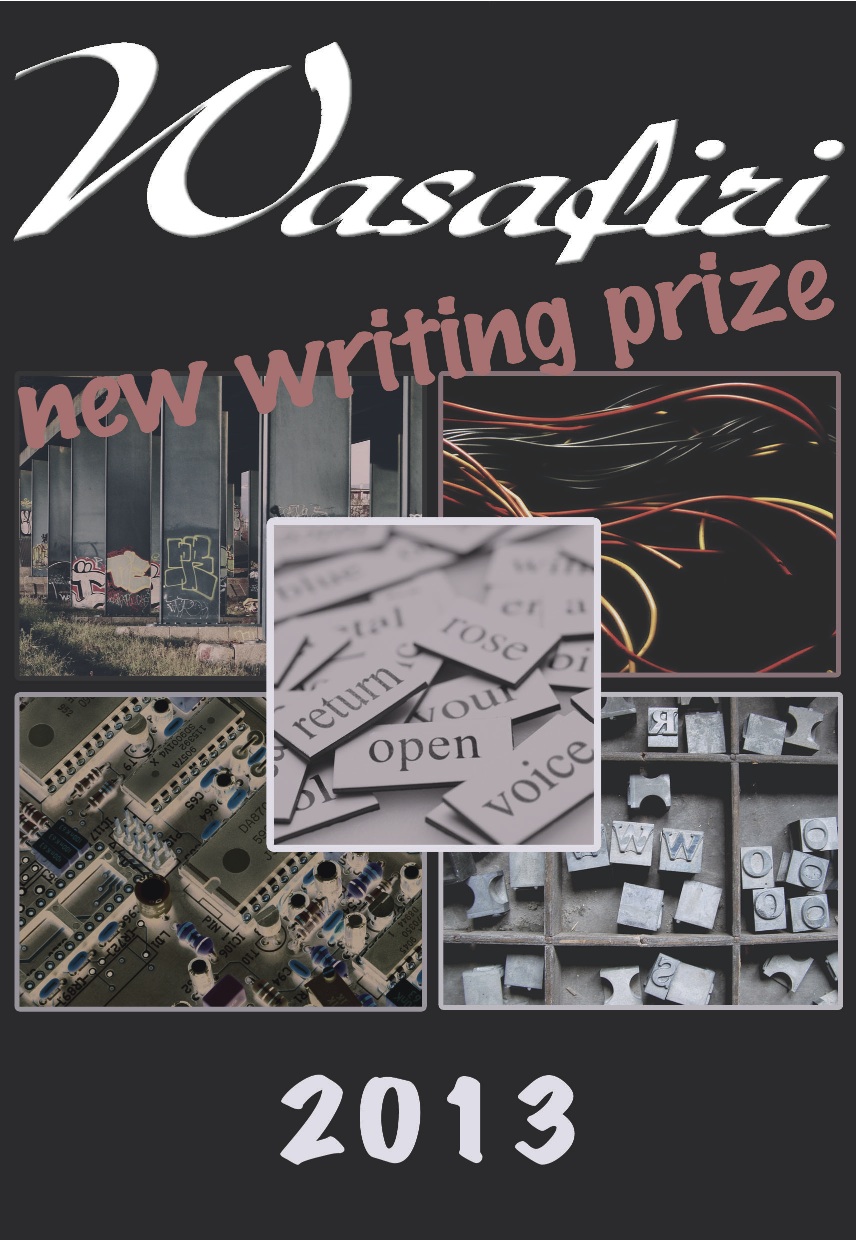
Wasafiri New Writing Prize 2013


Wasafiri is an international literary magazine that provides consistent coverage to Britain's diverse cultural heritage and publishes a range of diasporic and migrant writing worldwide. Wasafiri launched an annual New Writing Prize as part of its 25th anniversary celebrations in 2009. 

The Competition
The competition is open to anyone worldwide who has not published a complete book. We are looking for creative submissions in one of three categories: Poetry, Fiction or Life Writing. Simply fill in the entry form and send it to us with your entry and fee of UK Sterling £6.00 if entering one category, £10.00 for two and £15.00 for three categories. The closing date is 5pm GMT on 26 July 2013. Entrants who are visually impaired or who are prevented from typing through disability can enter work on audio CD.

Prizes:  £300 will be awarded to the winner of each category and their work will be published in Wasafiri.

Judges:
  • Susheila Nasta MBE (Chair) Editor of Wasafiri and Professor of Modern Literature at the Open University
  • Anthony Joseph Poet, novelist, academic and musician, author of three collections of poetry and a novel, The African Origins of UFOs
  • Tabish Khair Award-winning novelist, poet and critic, shortlisted for the Man Asian Literary Prize in 2010
  • Beverley Naidoo Writer for children and adults and winner of the Carnegie Medal and the Josette Frank Award
For more information, contact Wasafiri:  wasafiri@open.ac.uk