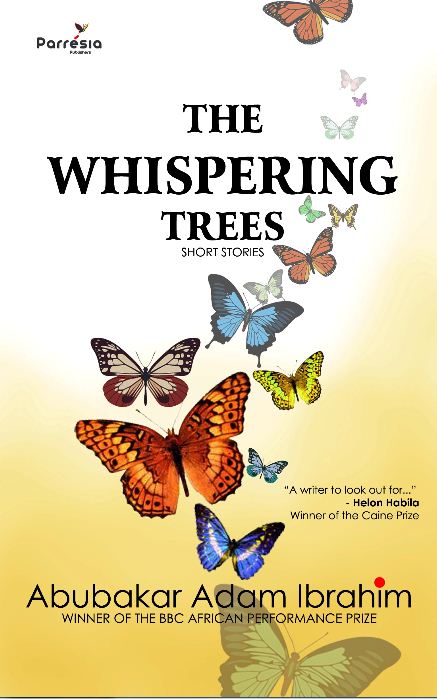
But whether writing a short story or a novel, the rudiments are essentially the same. First, the conception; that rousing moment when the inspiration comes, sometimes accompanied by pyrotechnics of iridescent lights floating in your head and making your heart beat faster. Sometimes it happens much in the same way as rainwater percolates into already damp earth.
This moment, for a committed writer, is always followed by the grunt work, the gestation period, if you like, where you crave solitude and exhibit some of those idiosyncrasies creative people are infamous for as you try to put your ideas into words. This is usually when even a lover’s voice sounds like an annoying intrusion into your thought process, the period when most people just don’t understand you.
In writing a novel, you go through
this process only once, a long drawn out process that takes years sometimes, but once none the less. For my short story collection, I had to go through the process repeatedly, fortunately, I had about a decade to do so.
It started with the title story sometime in 2003, I think. Second year in the university, taking a borrowed course in creative writing, we were required to submit a short story to make the grade. And when I kept having flashes in my head of Faulata’s face tending to her fiancé, a final year medical student, who had just lost his sight in an accident, I knew I had to write about loss and purpose and finding self.
I didn’t have a PC then; I had no idea how to use a computer, so I wrote out the story in long hand and took it to this business centre where I had it typed. I went to proofread and for whatever reason, the typist forgot to save the changes and printed out an error laden work. I don’t blame her much. She wasn’t well schooled and for some really strange reason, she filled her head with other notions quite unrelated to the short story at hand. I could understand that, of course, so I wasn’t so mad, but it took me quite a while to completely extricate myself from the gooey web she was trying to catch me in.
So, I submitted the story and forgot about it completely and went on to the grander idea of writing a novel, my first. It took me some three years to complete that. But then an old course mate called and in the course of conversation asked me about that story I had written while in school. He said he couldn’t get it off his mind after all those years and urged me to do something about it.
So I did. I had got a laptop then so I retyped the story and sent it to a webzine where it was promptly published. I was elated and encouraged.
Writing short stories need a constant upsurge of motivation, which is quite distinct from inspiration, and I found that in the Jos ANA writing group I joined later. Every fortnight, there would be a reading and critique session and in order not to go there looking stupid, I challenged myself to write more short stories often. I pluck inspiration from the birds twittering in the trees, from the winds whispering in my ears and from the intrinsic flashes of some phrases, bits of dialogues, a scene. This is an anomaly that constantly plagues me and gives me headaches if I am too slow to pen these things down. In such instances, the story continues to flow from that point, like a flower sprouting from an inkwell. I had even had a dream once and woke up to write a short story base on it. That story went on to win a prize.
And because I simply can’t afford rewrites, I’m afraid I do not have the luxury of time and I really have an aversion for rewrites, I am usually painstaking in creating the first draft, crafting every sentence as meticulously as possible, linking them up to reach a climax. The most I would do when revising is to tweak some sentences here and there, perhaps, rearrange a paragraph or two.
Eventually, I had quite a stash of short stories and it took another writer friend to tell me I had more than enough for a short story collection. He strongly urged me to consider putting them together and give it a shot. I reluctantly agreed. So I took on the dreary task of filtering out the dozen stories to go into a collection. And that, more or less, was how
The Whispering Trees was born.
Writing is a tough business. To be able to write, one must be able to wear the austere garb of solitude as comfortably as one would a sultan’s robe. One must learn also to be patient and tend to the story as one would a growing child – with much love and affection.
 |
| Abubakar Adam Ibrahim |
Among the twelve, there was only one I had to rewrite. It took me two years working on that story. I suppose it had to do with the way the inspiration came – in spurts and jerks, paragraph by paragraph. Sometimes a sentence or two. It just refused to flow. In between, I wrote other things, of course. When it all came together eventually, I started rewriting from the beginning.
Sometimes others flow, and within days the story is done and dusted. It is like pregnancy, each one comes with its peculiarities, you see. Not that I’ve been pregnant before, of course.
But I suppose the most important thing when writing is to love what you are creating and to have fun writing it. Craft every phrase and sentence with love. Write to communicate and not to impress, I think it works better.
The chances are that if you put your heart into crafting a story, your readers will feel it and it will resonate with them. So if the story stream isn’t flowing, take a break, read a book, play some games, go out and relate with other people – apart from the ones in your story. If you force the story out, it will be contrived and God knows I don’t like reading such, and I know a lot of people who don’t.
Sometimes, writing pays, in mega bucks, and sometimes it doesn’t. Most times, it doesn't, actually. But nothing, absolutely nothing, compares to the satisfaction one feels of having crafted a wonderful tale that you hope will outlive you and confer on you that rarest of things – immortality.