Tuesday, 10 July 2012

Soyinka @ 78: International Cultural Exchange Prog.


Zmirage Multimedia Limited (Nigeria and UK) and GlobalNewHaven (Nigeria and USA), organizers of the WS78 International Cultural Exchange programme “The Mind of a Patriot”, invite you to a lecture titled "From Tigritude to Transcendence: The Conscience and Conscientiousness of Wole Soyinka" by Robert Fox, Professor of English and Africana Studies at Southern Illinois University, United States of America.

Venue: Soyinka Hall, Freedom Park, (former colonial prison) Lagos
Date: July 12th 2012
Time: 11:00 am

The lecture, in honour of our patron, Nobel Prize Laureate Wole Soyinka on his 78th birthday, is billed to attract scholars, students, writers, artisans, culture enthusiasts and other professionals from business and public service. It will be moderated by the cerebral Professor Segun Ojewuyi of Southern Illinois University Carbondale.

RSVP the event by sending a mail to firo_po@yahoo.co.uk

Wole Soyinka headlined the Garden City Literary Festival in 2010. This is also to wish him a happy birthday from the GCLF Team as he clocks 78 on Friday.

Port Harcourt is the 2014 World Book Capital City!


UNESCO has just announced Port Harcourt as the 2014 World Book Capital City! Port Harcourt was chosen over such formidable cities as Oxford and Lyon. Congrats to the Rainbow Book Club and the Rivers State government. And we hope to see you at the special World Book Capital City edition of the Garden City Literary Festival in 2014.

Monday, 9 July 2012

Invitation: Closing Ceremony for FICWW 2012


You are cordially invited to the closing ceremony of the 5th edition of the Fidelity International Creativity Writing Workshop (2012) anchored by Helon Habila, Aminatta Forna and Sally Keith.

Date: Friday July 13, 2012
Time: 5 – 7pm
Venue: Oceanview Restaurant, Adetokunbo Ademola street, Victoria Island, Lagos
RSVP: Emma  - 08021322291, Uche - 0805506128

Helon Habila moderated the fiction writers' workshop at the Garden City Literary Festival, 2010. 

2012 Wole Soyinka Prize for Literature: Long List

The Lumina Foundation has announced the long list of the 2012 Wole Soyinka Prize for Literature in AfricaPast winners of the prize include Nnedi Okorafor, Sefi Atta, and Wale Okediran.

Sunday, 8 July 2012

Myne Whitman: Beyond Writing


The decision to self-publish my first book, A Heart to Mend, arose naturally from sharing excerpts of it on my blog. Subscribers loved the story, connected with the characters, and offered genuine feedback. They wanted more, and so I gave them the complete book. Some critics of self-publishing for profit have said that I could have provided a freely downloadable document, but by then, I had so many ideas that went beyond writing, and since I am a big believer in sustainability, I wanted these plans to pay their own way. 

The blog itself was an idea mooted at the writer’s group I belonged to at the time, and though I wasn’t new to websites and online forums, I had never considered a blog as a means of sharing my writing. At the beginning, the blog had the subtitle of “my journey to print”, and I did not know then that I would self-publish. I was editing the manuscript, which though complete was still in drafts, according the guidelines of the publishers I hoped would publish it. I pursued traditional publication of that manuscript, A Heart to Mend, for about six months before choosing to self-publish. 

I had gotten some rejections along the way that made it clear my writing did not fit the mould of any particular genre. From some editors, there were more details of the kind of changes I might have to make to get traditionally published, but I couldn’t see myself making some of those changes. So I did the necessary research into self-publishing and decided to go ahead. By choosing self-publishing instead of tailoring my writings to fit a pattern specified by traditional publishers, I knew I was making a choice to go beyond my personal goals. 

True, I wanted my writing to remain undiluted - and this is in no way a dig at other Nigerian authors traditionally published in the West – but I also saw an opportunity to realise other dreams, like being a sort of mentor to like-minded writers. However, this was not totally altruistic. As a publisher, I had to acknowledge the poor reading and book-buying culture among those who identified with my stories – mostly Nigerians - and I knew that if my book was to be read as widely as I wanted, I would personally have to be part of building up such readers and book buyers. 

A Heart to Mend was published in December 2009 in the United States, and released to good reviews in Nigeria in March 2010. When I won the Nigerian Blog Awards, my visibility increased exponentially among online Nigerians. Followership of my blog, Facebook and Twitter platform climbed to over 3,000 people, and I guessed it was time to put some of my earlier ideas into action. From my experience of blogging, publishing and promoting AHTM, I knew that it was essential to have an online space where the community I planned would feel comfortable.

This idea of an online space was validated by a collaborative fiction web-series I had successfully hosted on my blog. There were also the myriad of emails and Facebook messages I received in the wake of releasing AHTM. A lot of such emails were from aspiring Nigerian writers who wanted me to critique their writings, or act as their agents to traditional publishers in the United States. Some wanted me to publish them or help them find agents and/or publishers. I realized that a lot of them were quite talented, but unaware of the required processes in getting published.

That was how NaijaStories.com; launched in April 2010 as the premier community for those who read, write, or love Nigerian writing. I had found there were no social networks that promoted Nigerian books even as more and more Nigerians were using social media. NaijaStories.com showcases Nigerian writing, and combines elements of a writing critique website as well as a social networking site. This makes it versatile, allowing the writers to offer criticism of each other's work as well as attracting those who are interested in reading our kind of stories. 

Through the website, now with over 2000 members, we hope to build an army of people who will read and buy Nigerian books. It is also act as a central point where a global audience can read in one place, authentic stories written by Nigerians and about Nigerians. Recently, we have begun to attract traditional publishers and agents seeking writing talent or wanting to promote their books, and we also support writers who wish to self-publish. One of our goals is to establish a publishing company and release select works as anthologies and also commission full-length novels.

Born Nkem Okotcha and raised in Enugu, Myne Whitman spent most of her childhood reading, daydreaming or climbing trees and playing with the boys. She has a Master's degree in Public Health Research but has chosen her dream of spinning stories. She lives in the Seattle area; writes and blogs full-time. She also volunteers when and where she can. She is the brain behind Naijastories.comShe has published two novels,  A Heart to Mend  and A Love Rekindled. She moderated a session on social media and the book industry at the 2010 edition of the Garden City Literary Festival. 


Friday, 6 July 2012

A Harvest with Wole Soyinka

Every Sunday in July, there will be performances of plays written by Wole Soyinka at Terrakulture. Click on poster for more details. 

Thursday, 5 July 2012

“The Past is Always Better Than the Present”


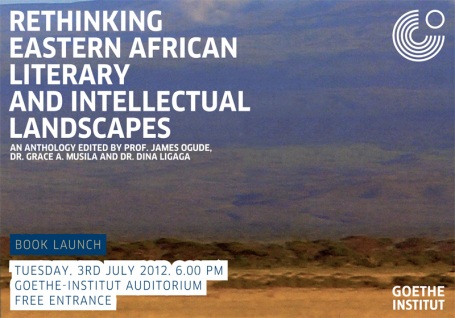
Rethinking Eastern African Literary and Intellectual Landscapes is a new book, a collaborative effort between East African academics, writers and thinkers. The book launched at the Goethe Institut in Nairobi on the 3rd of July, 2012.

While introducing the book, Dr. Tom Odhiambo reaffirmed the urgency and need of such endeavours by East African thinkers. He lamented the baleful disregard of arts and humanities by university administrations in Kenya where it frequently occurs that academics are unable to secure funding for their projects ‘because their work is not scientific enough’.

Dr. James Ogude explained how the book was conceptualized; it is an attempt at finding ways to re-energising intellectual scholarships within East Africa.

“We may work with the world, but it is necessary to have our own local interventions,” Ogude said. “A society that relies on foreign voices to tell its own stories is a dying society.”

Ogude recounted the intellectual climate of the 60s. “We have never looked back at that era and captured the intellectual traditions,” he said and illustrated how Ngugi and others led the intellectual revolution. “This book attempts to reassert East Africa as an important site of culture and intellectualism.”

Ogude shared details of his recent meeting with Ngugi. “Ngugi and I reminisced on those days gone. See, back then, we never quite realized the contribution of scholars in the region. And then Ngugi asked me where in Nairobi the book was to launch. He laughed when I told him, said we are still relying on the patronage of former colonial masters. What happened to our own homegrown spaces? Why do we never take the initiative?”

Ogude explained how received theories (from the west) inflected the manner of perception of our own experiences by reversing the hierarchy of our intellectual values. This is what Ogude terms as ‘The African Urgency’, one that needs to be addressed.

“The humanities are the crucible of society. We can produce technocrats, but society needs its thinkers.”

Dr. Godwin Murunga criticised the learning of African Studies as a distinct, monolithic unit. “I do not understand why, in this day and age, a university in Africa would teach African Studies. Have we, all this time, been studying aliens?” he asked. “Why must we depart from history, from literature, from art, and look for Africa in a place called ‘Africa Studies’?”

Murunga spoke of the global politics of education and the bearing of one’s academic affiliations to one’s global visibility (a severe reality that makes African scholars virtually invisible). He also spoke of the pitiful internal dynamics of our own institutions, the astonishing ways in which our universities self-annihilate.

Dr. George Ogola discussed the politics of the exiled African intellectual. He explained that diasporic intellectuals are often dismissed as inauthentic precisely because of their absence, a criticism that ignores the moral and material realities. Intellectual traditions do not follow linear trajectories, and many intellectuals and thinkers are so because of the anxieties of exile.

Ogola explained that the book is important due to its decolonisation of modernities, and due to the fact that the book not only focuses on Kenya or Africa but transcends it.

“This book is both historical and contemporary,” he said. “It redresses concerns of thematic insularities. It questions, for example, not just the patriarchy of European imperialism, but of African nationalism. What is the place of the woman as producer of intelligent output? Whose intelligent traditions are we engaging with, and where is the place of the woman in this?”

After a brief musical interlude during which the gripping Makadem performed, the audience was allowed to field questions. One particularly resonating one came from someone that spoke heatedly of what he termed as ‘positive primitivism’.

“The past is always better than the present,” he said, levelling his criticism against the intellectuals who looked back at the 60s and 70s through rose-tinted spectacles. “The revolution of the 70s meant to bring African voices at the centre of departments, and to put English aside. What then would have been the logical conclusion?”

He explained that in his opinion, African voices are best heard in African languages. In Kenya, there is a larger body of work in Swahili today than there was in English in all of the 60s, 70s and 80s combined.

“Why then do we say that literature has died? Back then, we were unhappy about expressing Kenyan voices in foreign languages. What we hear now is a dominant story, one expressed in English. Does it mean that if it a voice does not speak in English then it does not exist?”

In answer to this, Ogude expressed satisfaction at the growing body of work in Swahili and other local languages. He warned, however, that it will come to naught should this work be ignored by intellectuals.

“We need to engage with these works,” he said. He went on to address the criticism against such ‘positive primitivism’ with regards to the nostalgia of the 60s and 70s:

“Makerere, the University of Nairobi were functional institutions back then. We need not sweep realities under carpets. We must face ourselves, demand answers from ourselves. It is inevitable that intellectualism will plummet if student bodies increase exponentially without concomitant increase in academic resources. What we are seeing right now is a phenomenon where our students do not go through university, but university goes through our students!”