Thursday, 29 November 2012

Sani Aishat: My GCLF Experience

The Garden City Literary Festival is another medium to bring back the reading culture. Many have observed  that this generation, my generation, read less and that our reading culture diminishes by the day. 

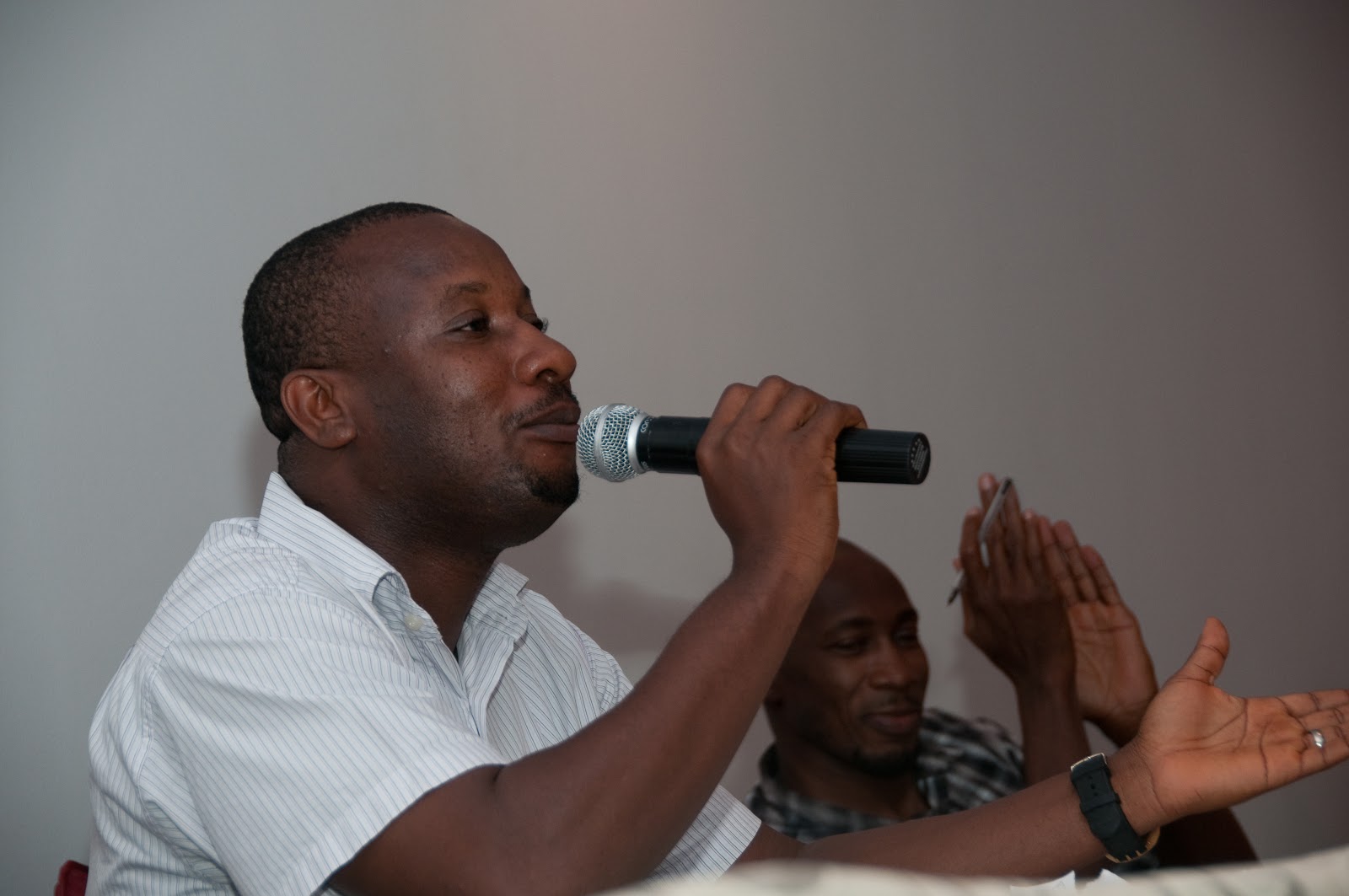
Open Mic Session
The whole festival was amazing and the participation by the individuals was been tremendous. The theme for this year's lecture makes it more interesting for me because of the undermining of female writers in African literature. This topic enables the female writers the opportunity to be heard by all.

Doreen Baingana facilitated the fiction workshop
Another thing that I like  about this edition of GCLF is that all the workshops, though didn't hold more than a few hours, really empowered people who attended it as their creative writing improved. Well for me. I really gained a lot attending this year's festival and the lectures were an eye opener to me because I learnt that being a writer is not easy. I learnt that for me to become an exceptional writer, it entails a lot of hardwork. Most of the facilitators and speakers emphasised that what makes a writer exceptional is for the writer to write, not just for writing sake but to endeavour to paint a picture of realism because literature cannot exist in isolation of the society and in so doing should give their writing their best shot.

Obari Gomba facilitated the Poetry Workshop
So far, so good, the fifth edition of the GCLF has been the best for me. There is still more room for improvement. I hope the next edition would even be better than this. 

Sani Aishat is a final year student of the Department of English, University of Port Harcourt, Rivers state. She was a participant at the Garden City Literary Festival, 2012.

Tuesday, 27 November 2012

NT Lit Mag: Call for Submissions

The NTLitMag is the literary magazine section of Nigerians Talk, and your writing is needed. This is a call for submissions for poems, prose, drama excerpts, articles, essays, lyrics, photography, and other art pieces of today's generation of writers. The LitMag aims to fill a creative space where the voice and perspectives of today's writers matter enough not just to provide a seminal direction, but also to define the present in creative terms.

Send all submissions to litmag@nigerianstalk.org, and follow NT LitMag on twitter.

Monday, 26 November 2012

Excuse Us: A Book Reading


Almost on a daily basis, we experience and hear about unbelievable occurrences, most of which are thought  possible only in Nigeria. We react in different ways. Some take refuge in a pub, where they analyse it all; others take to arguments at newspaper stands; a mass voice out on social media. A statement that is often thrown around is ‘Excuse ME!’ ‘Excuse Me!’ is of course the title of Victor Ehikhamenor’s soon-to-be-released book.

Parresia Publishers invites you to EXCUSE US!, an evening with Victor Ehikhamenor, author of ‘Excuse ME!’, and Emmanuel Iduma, author of ‘Farad’, to hold at 4pm on Saturday, December 1, 2012, at Patabah Bookstore, Shoprite, Adeniran Ogunsanya Street, Surulere, Lagos.

About the writers and their books
Victor Ehikhamenor is an internationally known visual artist and writer, born in Udomi-Uwessan, Edo State, Nigeria, and received his BA in English and Literary Studies from Ambrose Alli University. He holds a masters degree in Technology Management and MFA in Creative Writing from the University of Maryland, USA. Widely exhibited at home and abroad and avidly collected the world over, Ehikhamenor has also been a regular contributor to magazines and journals on literary and social matters since the early 90’s, as well as a fiction writer. He won the 2008 Leon Forest Scholar Fiction Award, and a Breadloaf Scholarship which he turned down to join Nigeria’s NEXT newspaper, owned by Pulitzer winning journalist, Dele Olojede in 2008. He served as NEXT’s first Creative Director and maintained a weekly column in the paper which has formed the bedrock of his new book. He also briefly served as the CEO and Editor-in-Chief at Daily Times, before leaving to start his own creative and strategic communication company, VEE Global Concepts. 

About EXCUSE ME!
“The man is a true Nigerian hero. And if you won’t take my word for it, fine. Read the harvest of his essays gathered here and see for yourself why I, like many, many others, rave about this young man.” – Professor Okey Ndibe, one of Nigeria’s most outspoken intellectuals, in his introduction to the book. 

Excuse Me! is a collection of sixty-three short essays carefully selected from the very best of Ehikhamenor’s weekly article of the same name in various newspapers, chief among them NEXT, in the two years that the paper and it’s online version www.234next.com defined the pinnacle of Nigerian journalism. It contains such satirical pieces as the jaw-breaking ‘Igodomigodo Must Not Comatose’ to irony-laden ones like ‘My Vote is for Sale.’ Deliriously funny pieces like ‘Midlife Crisis and Honest Visa Application’ are together with ‘I Want a Private Jet, So Help Me God’ and ‘The Iya Eba of Berkeley Street.’ Excuse Me! is Ehikhamenor, the artist, at his best with words. 

About Emmanuel Iduma
Emmanuel Iduma is the author of critically acclaimed novella, ‘Farad.’ He works mainly as a writer of fiction, nonfiction and poetry, and has won awards and received recognition in each genre. Emmanuel is the co-founder of Iroko Publishing, which has been publishing Saraba, an electronic magazine since February 2009. He is working on a second novel. 

Farad is reminiscent of Plutarch’s Parallel Lives, Farad eases to a climax when key characters from individual stories become participants in a conflict at a University Chapel—a conflict in which the nature of power is tested. Farad is an assemblage of fresh narratives woven around simple questions and open-ended complexities. It is, ultimately, a story of love and essence.

This event is a ‘must-not-miss.’ Remember:

Venue: Patabah Bookstore, Shoprite, Adeniran Ogunsanya, Surulere, Lagos
Date: December 1, 2012.
Time: 4PM.

Sunday, 25 November 2012

Poetry: Noah's Boat by West Biokpo Joshua

West Biokpo Joshua performed this poem at the last event, the poetry/Jazz evening, during the GCLF, 2012. The poem was rendered in pidgin English; got every one laughing and thinking. Enjoy it!

Noah's Boat by West Biokpo Joshua

Those days of Noah don come back
We dey defend; water dey attack
Minji don break bounary run enter town
YEEPA! disaster don wear crown
Pandemonium don get temporary shelter
We fast past Ben Johnson as we run helter skelter
The earth wet, no dry place
Laugh dry like kpanla for my face
As I see suffer in black and white
Inside some hearts, frustration don get permanent site
Eight years medicine school and Mmiri take my CV
Poverty don best some people wey I see for TV
Garri sink, hunger float
Nature dey boasyt, destruction dey gloat
Heaven pity our complain
The tears wey she rain don worsen our complain

Abegi, na where Noah boat dey?
Why una no tell me say e go be like this today?
God give Baba Noah warning: Flood dey come
But my people about salaries dey drum
With dem big agbada and labalaba sokoto
Dem dey tell me stories from Gbagada to Sokoto
Politician see water speak heavy grammar
Wey knock my head like say na sledge hammer
Relief Relief...make una wait for relief
And them wan me to believe
Wey I know say sa dem dey go
Dem promises dey follow.

Saturday, 24 November 2012

Ngugi's House of Interpreters


Ngugi wa Thiong’o has a new book; it is a memoir. Reviews are already coming in; it is left for you to decide whether Ngugi does justice to his story, to history by reading a copy.

Scotsman.com writes;
This is a compelling memoir, and an interesting companion to his novels: I hope further volumes are being written. It is odd, however, that there is no note to tell the reader whether Ngugi wrote this first in English or Gikuyu, given how important the use of indigenous languages has been to him (indeed, it was the point of disagreement between Achebe and Ngugi). He has in the past translated his Gikuyu into English and spoken movingly about English having a redemptive role as a “meta-language” in allowing minority languages to communicate with each other. Either way, a fine and fiery book.

Hector Tobar of LA Times writes;

"In the House of the Interpreter," the new memoir by the celebrated African writer Ngugi wa Thiong'o, takes us to the hopeful and turbulent world of 1950s Kenya. And it begins with a startling image.

Ngugi is a teenager, returning home from his prestigious boarding school. He's finished his first term at the top of his class and is still wearing his khaki school uniform and blue tie. Carrying his belongings in a wooden box, he reaches the ridge where his village should come into view. But it's not there.


Thursday, 22 November 2012

Favourite Five: Mazi Chiagozie Nwonwu

Mazi Nwonwu is a Lagos based freelance writer and editor. He writes non-fiction, science fiction, present reality and stories set in his world -- the fictional Land of the Seven Hills. His non-fiction has appeared in local and international publications, both online and offline. His fiction has been published by Storytime, African Writer, Sentinel Nigeria, Naijastories and others. He is currently trying to live up to his promise to review every African fiction he reads.

His short story collection Footsteps in the Hallway will be published in the first quarter of 2013 by Melrose books. He blogs at fredrnwonwu.blogspot.com and publishes his reviews via Africanwriterstrust.com and 7venhillsmedia. He also writes a column for DailyTimes.com.ng. We asked him to send us his favourite five books, he had this to say before the list "Five favourite books? Hmm. This is turning out to be harder than I thought. I have read thousands of books and dozens come to mind as I try to zero down on five. Ok. I think I may have to do this randomly."


Grass by Sheri S. Tepper
"Grass! Millions of square miles of it... a hundred rippling oceans, each ripple a gleam of scarlet or amber, emerald or turquoise... the colors shivering over the prairies... Sapphire seas of grass with dark islands of grass bearing great plumy trees which are grass again."

Thus did Grass, which surely will forever be on any favourite list of mine that is not restrictive, begin. Grass is a science fiction novel that will find space on any literary fiction shelf if language is a criteria. Marjorie Westriding Yrarier, the main character, is one of those that you want to meet in person and the conflicts are exquisitely handled.

Imajica by Clive Barker
If I didn’t buy Imajica from a bend-down-select bookseller at Ikeja Under Bridge some years ago, perhaps I would never have started writing a novel about a man who loved his wife so much that he felt it would be better to kill her than to lose her to another. Imajica is one of those books that cradle the world of science fiction, fantasy and horror, only this one does it better than any other I have read. Gentle, the main character stayed with me and the one-foot distance between parallel realms that have little in common was exhilarating.

Blackbird by Jude Dibia
Blackbird is beautiful, it is a book that I want to buy and gift to everyone that has ever told me “...but I don’t read Nigerian writers.” With Blackbird, Jude Dibia showed me that exquisite novels could be written by home based writers of my generation without pandering to script of western literary award organisers. Blackbird for me is one of those books you remember with a smile. Well written, balanced and delightful to read.


Fine Boys by Eghosa Imasuen
Eghosa Imasuen is a damn good writer. His word usage is the closest thing to Naija speak I have seen in any book. I wrote in my review of this book that it will inspire a new kind of Nigerian writing and I still stand by that. The story of many in my generation, Fine Boys is a statement; a poignant record of time’s passing. Yes, I also want to dash this one to everyone I meet.

African Delights by Sipiwo Mahala
African Delights is the first book I reviewed with a word count of over 2000, yet I still feel that I did not say all I wanted to say about the book. This short story collection could very well be a historical narrative of Sipiwo Mahala’s native South Africa. I loved every story in this collection. I loved the language, the unapologetic telling and the honesty it conveyed. Very few copies of this book exist in Nigeria at the moment and I am gloating over the fact that I own one. Will I buy it to dash? Sure, but my autographed copy won’t leave my house without me.

Five already? Well, as I said, this is random. Now I remember several other books that should be in my favourite five. 

Commonwealth Writing Competitions 2013


There are two categories; the Book Prize and the Short Story Prize

The short story prize is awarded for the best piece of unpublished short fiction (2000 – 5000 words). Submissions must be made by the author of the short story. Regional winners receive £1,000 and the overall winner receives £5,000. Deadline for submission is Tuesday 4 December 2012 (12 noon GMT)

The book prize is awarded to any first full length novel for an adult readership is eligible for the Commonwealth Book Prize subject to the further eligibility clarifications. Drama, books written for children, anthologies of short stories, collections of poetry and graphic novels are not eligible. There are no restrictions on setting, theme or genre.

Click the links for more information on the competition. All the best!