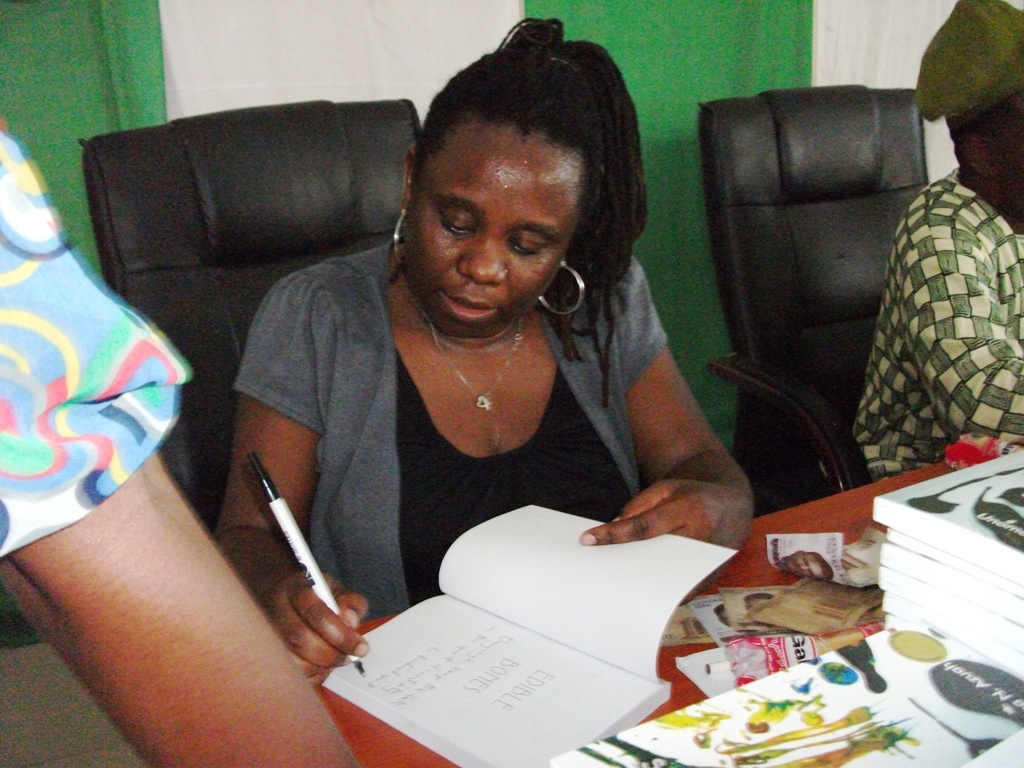
Since my debut novel, City of Memories, was published, I’ve been asked the question "How did you write your book?" by several younger and unpublished friends. Usually this question has nothing to do with the book itself, which most questioners had not read at the time of asking; it has more to do with the imaginable effort and discipline, the regimen and private process they assume must have brought the book to their bookstores.
For me, the story of writing this novel began in 2005, or thereabouts, when I wrote a short story, "Fragments of a Profane Love”—silly title, I know! I was interested in short stories then and had written quite a number, but “Fragments" remains the longest at about 9,000 words. This was at that time when civil strife in Jos, where I live, was getting out of hand and we, yan’Jos, were getting a lot of negative publicity because of the simplistically tagged “ethno-religious” nature of these conflicts. After the media had tagged it, some people began to align themselves with the media rhetoric—beginning to believe they had either ethnic or religious stakes in lopping off the heads of their neighbours. I was at Zaria at that time, a law undergraduate who had just started thinking seriously of writing. So, a thought came to my mind—what if the very first civil crisis in Nigeria had proceeded from a love affair, as the fallout of a private vendetta gone publicly wrong? I thought that would make today’s kill-and-burn heirs really pathetic and foolish—and maybe they might stop to think and change their ways. That was how the story of Ummi, princess of Bolewa, and her two lovers Ahmed and Usman was born. Experimenting with style, I used multiple points-of-view, telling the story from Ummi, Hussena and a few other unnamed characters perspectives. Eventually, when the idea of writing my novel came up, the story in "Fragments" became the bracket around the present novel—for Ummi, dead at the time
City of Memories starts, is the mother of one of the main characters and wife of another.
The actual writing of the book started sometime in late 2007, December maybe. I had been about six months out of the University and there wasn’t a whole lot to do. So I decided to write. It was a heady time for me: five of my poems had been published in Chuma Nwokolo’s
African Writing months before and Toni Kan, one of the more recognizable names in Nigerian writing, had said I was “a writer to watch!” So, I said, Richard Ali, go write yourself a novel! I didn’t let the fact that I knew nothing about novels—
beyond my reading—bother me. I took "Fragments", my short story, printed it out and tried to imagine other complementary stories—a rudimentary structure. When I was satisfied, I started writing. I would average two to three thousand words a day and the very first draft of the novel was completed in six months—let’s just say I felt very pleased with myself. Then I started editing; I believe I went through about three rounds of editing from word one to word last. Then, very confident of myself, I shared it with a few older writer friends. That was when I knew something was wrong, for while most praised my effort, none said it was good. I became frustrated and abandoned the manuscript.
I only went back to the manuscript in late 2010 by which time my friend and fellow British Council Radiophonics participant, Uche Peter Umez, had introduced me to Nigerian writer
Jude Dibia who read and liked the manuscript. When I go over those older versions, I see clunky, long sentences lacking a shred of elegance, and a plot that wasn’t really going anywhere, just stuff happening to the same people. There was no trigger, no plumbline, no real plot really—a reader of those early versions would not have cared to know what happens next. Jude Dibia was the doctor who worked on the MS and showed this writer how a plot works, offering invaluable lessons in such crucial things as point-of-view. He also gave my novel the necessity of conflict, all the things I should have known before putting a single word to paper. Mentoring is very important, I can’t stress this enough, just as I cannot appreciate Jude Dibia’s mentoring me enough—he didn’t even accept a single naira in payment. By the time JD and I were done, the novel had started to assume its present form. Two more rounds of editing were then done, with
Azafi Omoluabi-Ogosi, who later became my business partner at Parresia Publishers Limited, and lastly with Rose Kahendy, Parresia’s external editor.
So, when I’m asked, how did you write your book, the correct answer is not really that I wrote it into being—I rather edited it into being. And editing is really hard work. There are very few writers, I know of none, I’ve heard of none, who can write a book that would be perfect as it is; in fact, the writing is the least bit of it. It is the editing process, whether done alone or with an editor, that near political process of choosing words and weighing sentences—that is where the book emerges from.
"The birds and the weeds are the two sorts of editors we have—the first share the author’s vision though they can be impatient and try to assimilate the author's voice into their own style; the second, the weeds, do not share the author’s vision and have got to be avoided in the same way a weed infestation must be fought."
So, writing requires two kinds of people—a mentor, and an editor or editors—who share one thing in common: your vision. I think an image would suffice—an agricultural one. Farming is an activity for which all you need really is a piece of land, but agriculture, that great science, is a synergy of efforts to coax the most out of that bare piece of land, a piece of land that must be studied as one would a person one desires something off. Depending on the soil, fertilizers, ranging from carefully cultivated compost to higher-end chemicals, would be added. And there is the human effort, the farmer’s just one of these, others can be hired hands or family, a wife, children. The birds too, come to help fertilize the crop and sometimes demand their share with impatience; the weeds keep the farmer on his feet. All these are participants in the science that puts bole and fish at Mama Mercy’s corner, ready for your 100 naira. We must imagine our written words to be that barren piece of earth, the writer as the farmer. But it is the effort of the birds and the weeds that bring about the fruition of the preceding effort. The birds and the weeds are the two sorts of editors we have—the first share the author’s vision though they can be impatient and try to assimilate the author's voice into their own style; the second, the weeds, do not share the author’s vision and have got to be avoided in the same way a weed infestation must be fought. And who is the mentor—the mentor is that invisible need to affirm oneself by conquering nature, something elemental.
I hope these ideas will help you find the book you’ve been meaning to write and I look forward to reading it.