Showing posts with label gclf 2012. Show all posts

Thursday, 29 November 2012

Sani Aishat: My GCLF Experience

The Garden City Literary Festival is another medium to bring back the reading culture. Many have observed  that this generation, my generation, read less and that our reading culture diminishes by the day. 

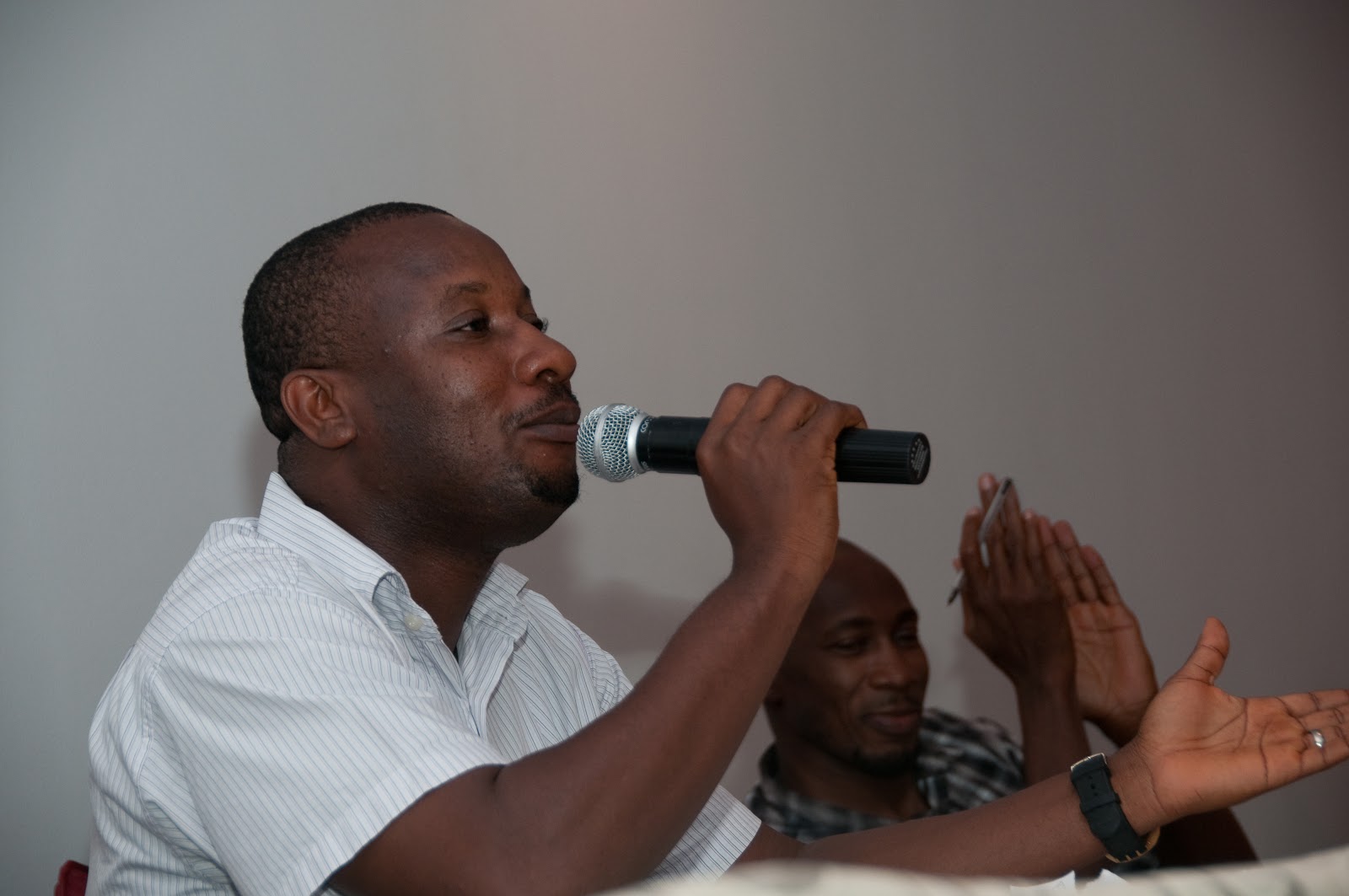
Open Mic Session
The whole festival was amazing and the participation by the individuals was been tremendous. The theme for this year's lecture makes it more interesting for me because of the undermining of female writers in African literature. This topic enables the female writers the opportunity to be heard by all.

Doreen Baingana facilitated the fiction workshop
Another thing that I like  about this edition of GCLF is that all the workshops, though didn't hold more than a few hours, really empowered people who attended it as their creative writing improved. Well for me. I really gained a lot attending this year's festival and the lectures were an eye opener to me because I learnt that being a writer is not easy. I learnt that for me to become an exceptional writer, it entails a lot of hardwork. Most of the facilitators and speakers emphasised that what makes a writer exceptional is for the writer to write, not just for writing sake but to endeavour to paint a picture of realism because literature cannot exist in isolation of the society and in so doing should give their writing their best shot.

Obari Gomba facilitated the Poetry Workshop
So far, so good, the fifth edition of the GCLF has been the best for me. There is still more room for improvement. I hope the next edition would even be better than this. 

Sani Aishat is a final year student of the Department of English, University of Port Harcourt, Rivers state. She was a participant at the Garden City Literary Festival, 2012.

Monday, 19 November 2012

Elechi Amadi: Major Tools of Fiction

Author, Elechi Amadi took the master class lecture for the fiction workshop during the Garden City Literary Festival, 2012. For those who could not make the class, here are the highlights from the class. We hope that you are able to learn one or two things. Welcome to class!

Novelists employ standard techniques which help them achieve success. The following are some of the important ones. 

1.) Realism is achieved when the reader is led to suspend his disbelief, that is, to forget that what he is reading is imaginary and not true. To achieve this, the author should observe the following:
a) The setting, language and characterisation should be harmonized into a credible whole.
b.) The author should not allow any doubt or contempt for what he is describing because the reader will certainly share his attitudes.
c.) Where possible, details showing intimate knowledge of what the author is describing should be included.
d.) When convenient and plausible, the story should be linked up or have echoes of real life events. (For example, the influenza of 1918 in The Great Ponds)

2.) Suspense
a.) Throughout the story, there should always be something which the reader is looking forward to. This creates suspense.
b.) As much as possible, what the reader looks forward to, should be kept uncertain. 
c.) When the end appears certain, there should be some side issues that should keep the reader in suspense. (For example, if the death of the hero is certain, then other things which should happen before the hero's death could sustain tension)

3.) Humour and Entertainment: Humour is strongly linked to entertainment and this must be kept in mind throughout the story. There must be enough humor here and there to relieve tension and amuse the reader. 

4.) Irony:  This is said to occur when an action produces an effect opposite to, or at least very different from that expected. Irony may be comic or tragic. E.g in The Concubine, Ihuoma's son kills Ekwueme while Ahurole's love portion drives Ekwueme into Ihuoma's hands. In Things Fall Apart, Okonkwo the hero of the tribe dies ignominiously and does not even get a decent burial.

5.) Flashback: By this technique, the author is able to suspend the narrative temporarily in order to recall past events. E.g. Alekiri's account of her war experience in Estrangement.

6.) Stream of Consciousness: By this technique, the author "plays god" by x-raying the minds of the characters and letting the reader know what they are thinking. This provides useful insight into their characters and motivations. E.g as seen in Estrangement, pages 86 and 100. 

Elechi Amadi holds writing workshops for interested writers at his residence in Port Harcourt. For more details check his website or call: 08033398036 

Wednesday, 14 November 2012

Princewill Udom: My GCLF Experience


Hotel Presidential, the venue of the fifth Garden City Literary Festival, wore an unusual radiance at the behest of the natural sunlight and the impressive events of the festival. The event had a stellar cast including Nigeria’s finest Wole Soyinka, Gabriel Okara and Elechi Amadi, to mention a few. The festival drew high profile academics, public officials and emerging literary talents. In line with this year's theme, "Women in Literature" the guest authors were all female writers; Veronique Tadjo, Doreen Baingana and Chibundu Onuzo.  

This convergence of the crème de la crème in the world of African literature was complemented by the captivating array of scheduled programmes. At the book fair, elusive books as well as new books were available. For the workshops, most participants were pre-registered, so signing up was easy. The ushers and gatekeepers, who were mainly young people, welcomed everyone with smiles. They brimmed with enthusiasm and a genuine desire to help. They wore their distinctive branded black T-shirts on Jean trousers. The seminar rooms were well-lit and air-conditioned; they had comfortable chairs, giving the rooms both functionality and aesthetics. 

The events for children had various small groups of excited uniformed schoolchildren in attendance. The fiction seminar played host to an inspired set of aspiring novelists exclusively while bona fide poetry lovers had their seminars simultaneously in a separate room. However, other events had unrestricted access. But all events stood out by their interactive approach, among which was the discussion by the three female authors on the theme of the festival.  There was also a   dance drama on VVF by an all-female troupe from the Arts Village, University of Port Harcourt; this triggered a reflection on the broader themes of illiteracy, tradition and injustice. 

All the events were free. Indeed, I consider that outstanding considering the rewards participants garnered such as the opportunity to hobnob with established writers and receive invaluable insights from them, 

It was particularly pleasing to find a sizeable proportion of young participants at the festival whose presence infused the older generation of writers with the firm optimism that the writing profession has a living legacy.

In sum, the festival as a whole was a valuable lesson in impeccable organization.

This article was sent in by Princewill Udom; he was part of the GCLF writing workshop, 2012. 


Monday, 12 November 2012

Poetry: Stand Ye Up!

This poem was performed during the open mic session of the Garden City Literary Festival, 2012. The writer, Uche Anichebe, is a 500 level student of the Faculty of Law, Nnamdi Azikwe University. Though she was part of the Fiction workshop class, her performance of her poem "Stand Ye Up!" got everyone clapping during the open mic session during the GCLF 2012.

At the GCLF, we support writers with promise, one way or the other. We recognise talent when we see one. We enjoyed Anichebe's poem because it fits into the theme of this year's festival, Women in Literature. The performance was also profound, as her voice charged the women in the audience to take their place in the world. Read it and tell us what you think. 


STAND YE UP! (Dedicated to all women who are proud of their gender)

The breasts that suckled the nation's best
The hand that fed and lifted men
The womb that bore all men that live
and in agony, gave breath to them.

Stand ye up with the greatest pride
Stand ye up from the lowly state
And view the wonders that lie in thee
The splendour of the rising sun

Created when all things were still
In man's repose and nature's charm
When all was made so he needn't rush
He created you from tested stuff

Stand ye up with your royal gait
Stand you up with majesty
For ye have borne great loss and loads
Ye who hold the future's gift.

Ye are a priceless gift to man
The Ken that saved the Jewish land
The womb that bore the saving Lord
The loving heart from Calcutta

Stand ye up and know thy worth
Stand ye up with dignity
Stand ye up and know thy rights
and guard them from the treading toes.

---Written by Uche Anichebe

Sunday, 4 November 2012

Koko Kalango: A Reading Society is a Thinking Society


I am honoured to stand before you today to welcome you to this wonderful city of Port Harcourt and to the Garden City Literary Festival 2012. This year’s festival is special for several reasons: this is our 5th outing and we are looking at a very topical subject: Women in Literature, with a focus on Africa. This broad theme is interesting because it allows us to examine the work of women who are operating in the literary space - writers, publishers, booksellers, literary critics. We will also be looking at what women write about and how relevant female writing is to our modern world, plus we will be looking at the way women are portrayed in literature.

To tackle this exciting topic, we are joined by authors, critics, scholars and the reading public. We welcome our main guest writers – Veronique Tadjo, the Ivorian poet, songwriter, playwright and scholar, Doreen Biangana, author of Tales from Entebbe, from Uganda, Chibundu Onuzo the talented young author of The Spider King’s Daughter and Noo Saro Wiwa writer of Looking for Transwonderland; Travels in Nigeria. In addition, we have a brilliant line up of workshop facilitators, discussants in the symposium and seminars, exhibitors at our book fair and of course our visitors, who are the backbone of this festival.

We are also pleased to be presenting our book; Nigerian Literature, a Coat of Many Colours, which is a coffee table book highlighting the works of 50 prominent Nigerian authors.  We are grateful that the foreword to this book is written by no less than President Jonathan while the introduction is written by Rivers State’s leading literature connoisseur - Governor Rotimi Amaechi. We hope this work will be a valuable contribution to Nigeria’s literary heritage.

There is another reason why Garden City Literary Festival 2012 is important; -  this year, our beloved city of Port Harcourt has been chosen to be UNESCO World Book Capital 2014! This is both an honour and a challenge to our city and we stand on the platform of our 5th festival to announce our nomination to the world. Port Harcourt has some exciting times ahead.

Over the years we have featured writers of this great city such as; Elechi Amadi, Gabriel Okara, Igoni Barrett, Kaine Agary and Chimeka Garricks. On this historic occasion those of them present will join us in the symbolic unveiling of our beloved city of Port Harcourt as UNESCO World Book Capital 2014. 

This city has previously welcomed literary legends such as the Nobel Laureate Wole Soyinka, Ngugi wa Thiong’o, Koffi Awoonor, Ama Atta Aidoo, J P Clark and their younger counterparts like Chimamanda Adichie, Sefi Atta, Helon Habila, Adaobi Nwaubani and Zainab Jallo to the city for various literature programmes. Last year, we even had the privilege of hosting two important world figures as guests of honour – Chief Emeka Anyaoku, the former Secretary-General of the Commonwealth and the Rev. Jesse Jackson the American civil rights activist.

But for every big name, there are several others, not so well known, but very important men and women, boys and girls, being groomed on this platform. It is our desire that the festival will continue to be a platform for expression and exposure of writers as well as a place where all players in the book chain industry – from readers to writers to publishers - will be able to meet, network, exchange ideas and do business.

The vision that I hope we all share for Port Harcourt is of a city where literary talent is nurtured and where reading and writing is the norm. A city where aspiring writers are encouraged to soar to new heights. A city where the writer is free.

We have said before that our work is a double edged sword – reading and writing. If you take a look at our logo, you’ll see that it has a map of Africa in it, with light emanating from Port Harcourt to the rest of Africa. This portrays the vision of the Rainbow Book Club to use literacy as a tool for development in Africa, beginning right here in the city of Port Harcourt. The light in the logo signifies enlightenment and that is what literacy does for a society.

A reading people is a thinking people. In a reading society, a thinking society, when we see a broken down fuel tanker, we do not take our buckets and go there to fetch petrol to sell for a little money. A thinking person knows that this a dangerous thing to do as a single match can start a blaze that can kill dozens of people in minutes.

A reading society is a thinking society. In a reading society, when ravaging floods turn our country into one vast swimming pool and our possessions are floating away before our eyes and we realise our livelihood is threatened, society as a whole would come together to find a solution to find a way to survive. 

If four boys between the ages of 18 and 24 in your community are accused of anti social behaviour like stealing a laptop and a blackberry phone or even more serious allegations – like cult activity - what would a thinking society’s response be? Faced with such a situation, the thinking society would realise that suspects are entitled to a fair hearing in a court of law and if found guilty, then those suspects will pay the penalty according to the law. A reading society would not drag those suspects through its streets, beat them up, strip them naked, pour petrol on them and burn them like logs of wood. The reading society does not take the law into their hands, and kill people without mercy.  No, that is not the response of a reading society, that is not the response of a thinking society.

Some people say this is the result of poverty and they ask, ‘does reading put food on the table?’  The link between reading and prosperity lies in the fact that we live in a knowledge economy. To cope with the demands of our present world, developing our human capital is essential. Reading is a sure way to access information. Information is power. Information exposes you to the stories and examples of others from which one may learn how to improve on their own life. More importantly, information opens doors that lead even the poorest people to new horizons.

Reading brings light. That is why our logo has a light from Port Harcourt to the rest of Africa. When light comes, darkness is dispelled and the society can develop. That is the task at hand. With Port Harcourt being nominated UNESCO World Book Capital 2014, the world now has its eyes on this city and we must stand up to the call to be a beacon to the world.

This is a call to humanity, a call to you and me. Don’t look behind you, there is no one there to take on the challenge. The challenge is thrown to you and me. We must work together to show the world that we are indeed a reading and thinking people.

In 2005, I quoted the saying that if you want to hide something from a ‘black’ man, hide it in a book. I don’t agree with the designation ‘black’ but this is not the occasion to postulate my personal ideology. I will repeat what I said in 2005, in this hotel, and that is that by the time the Rainbow Book Club is through with its work, the world will have to find somewhere else to hide information from the ‘black’ man.

Ladies and Gentlemen, welcome to Port Harcourt, UNESCO World Book Capital 2014.
Welcome to the 5th Garden City Literary Festival.
Welcome to the road towards a thinking society.
God bless the Garden City of Nigeria, God bless Nigeria!
Welcome!   

Friday, 26 October 2012

Doreen Baingana in Conversation with Igoni Barrett

Igoni Barrett, author of From Caves of Rotten Teeth,  introduced Doreen Baingana, two-time shortlisted author for the Caine Prize for African writing. After this, Doreen read from her collection of interlinked short stories Tropical Fish: Stories out of Entebbe. We meet a girl who through her words, transformed into a woman; she was exploring her parents' room, and at the same time, the world.

Barrett dived into the conversation, asking interesting questions, raising interesting issues, rousing some dust. How should writing--if it does--address women's issues? How does her work Tropical Fish achieve this? For Baingana, "writing should first of all, it's about entertainment, enjoying words, and language. Also, the story is about the exploration of being human, of a young girl transforming into a woman. For her, it's all a game of adolescence. It helps us understand what makes us men, what makes us women and it helps us address these issues."

The African publishing sector is undergoing changes. However, Barrett wanted to know if female writers face any particular challenges that their male counterparts do not experience when it comes to publishing? Baingana thinks the challenges that face African publishing are not gender selective however "there are challenges that we face as female writers. The challenge for me now is that I have a four-year-old child. Writing is something that takes a lot of time, mental space but raising a family also takes a lot of time."  She equally considers being a writer, being a female writer in Africa a privilege "Just to become a writer is a privilege; it has to do with the kind of education that you got, that you had access to proper health care. You don't become a writer out of the blues but it is because of how you were brought up, a sum of your experiences. There are challenges that women face when it comes to education." (Find out stats about female education in Africa). Doreen Baingana studied Law at the Makerere University, Kampala and has an MFA from the University of Maryland, after which she returned to Uganda, where she still lives. 

Baingana also talked about women writers and self-censorship. The society does not think that women writers should be sexually explicit, not in reality, definitely not in writing. She says "You may not realise how much you are self-censored. There are some of my stories that are sexually explicit however there are women who do not write such because they self-censor." 


Barrett also wanted to know if there are any such things as women issues. If there are, how does Baingana's writing address them as a female writer? In response, Baingana delves into the world of publishing and its tags for female writing "I think that publishers take female writers as writing about women issues but they take male writers as writing about human issues. So many men get published because of that and there are many women who could have gotten big but are not."

Baingana accepted that she addresses issues pertaining to women in her writing. She made a case for her choice "I think it is about being marginalised, silenced, then you have to make a bigger push to be seen. We have to portray reality. Women are a complexity of characterisations and fiction should show that. Right now, I prefer seeing through female characters. We should be free to write whatever we want."

Baingana is known for her fiction for which she has won awards. However, Barrett made the audience know that she once tried her hands on poetry. She had this to say about her poetry which she called "unpublishable" "I used to write poetry, I still do; for me, poetry is just an emotional outlet. I am still very interested in poetry, and in language though I am better with fiction. So, I sneak poetry into my fiction sometimes." 

What role does art play in the society, if it plays any? Baingana made a case for arts. "My initial belief is that art can be valued even as a beautiful thing. However art can help in social development. As writers, we learn to express ourselves about how to be in this world. Art helps us reflect on the realities in the society; look at what art did with apartheid in South Africa. Art can also help with female emancipation. There is also the catharsis too that you feel when art makes you feel better."

Baingana was asked to describe Nigeria, to a Ugandan friend; she had this to say "I fear generalisations. If you write about it, then you can be specific. The diversities her are remarkable. When you go to a different place, you see things starkly: how do you eat hot suya in really hot weather? There is a lot of energy here, a country full of energetic people. I think Nigeria should work more on its public relations because we hear more of the negativity."

The floor was opened to the audience who asked a variety of questions: what should be the impact of writing? What advice do you have for budding writers on publishing? How should women writers deal with motherhood, housework and writing?  To the last question, she responded in a funny way "then they have to stop doing housework." Then more seriously, she continued "Most women do not have a sense of self. It is very important for women to create time for themselves. There is the whole issue of work-life balance and it's in finding what's comfortable. It's about the choices that you make in your life.  It's unfortunate that people think that you are a "good woman" yet you do not have time to write. What does it mean to be a writer to you? What does it mean being a woman? If you need to write and deal with the household, then hire a maid." She concluded, the audience laughed as they clapped and proceeded to the back of the hall for Baingana's autograph. 

Saturday, 20 October 2012

Creative Workshops with Polly Alakija

Today, the children will show the whole world what they have been working on, all week long: paintings, performances and dances. Are you ready? Here are pictures from the different workshops. The venue is the Main Banquet Hall, Hotel Presidential. Time is 1pm. 

Children at work with Polly Alakija

I can paint!

We love listening!

All eyes on the teacher

Watch me as I do this!


Still in the works

In the works

See our inventions


Thursday, 18 October 2012

The Voice Diary: October 18, 2012


Today, there were three main events: the public presentation of Port Harcourt as the UNESCO World Book Capital, 2014; a "Role Model Reads to Children" event where Dame Alice Lawrence Nemi, the Honourable Commissioner for Education, Rivers State read to children;  and a book signing session. All events were open to the public. The first, that seemed to be the highlight of the day was the official presentation of Port Harcourt as the UNESCO World Book Capital City, 2014. In attendance were the Nobel Laureate for Literature, Professor Wole Soyinka; the Commissioner for Information, Rivers State, Mrs. Ibim Semenitari who represented the Governor of Rivers State, HE Governor Rotimi Amaechi; the Country Representative of UNESCO, Dr Joseph Ngo who represented Director General of UNESCO, Irina Bokova. Seated also were the guest writers for the Garden City Literary Festival, Doreen Baingana, Veronique Tadjo and Chibundu Onuzo. Also seated were writers from the city of Port Harcourt, Igoni Barrett, Chief Elechi Amadi, and Pa Gabriel Okara. 

The event which was co-hosted by Who Wants to Be a Millionaire host, Frank Edoho opened with music from the Rivers States Schools Orchestra. The group of young children also led the audience to sing the National Anthem, which seemed to take on a new meaning, as the second stanza ended "...Great lofty heights attain, to build a nation where peace and justice shall reign."

Throughout the event, it seemed that every speaker focused on how as a country, we can attain lofty heights by supporting the ideas that literature carries. Koko Kalango, the Festival Director gave the welcome speech; she talked about the motive behind the title of this year's festival "The broad theme is interesting because it allows examine the work of women who  are operating in the literary space- writers, publishers, book sellers, literary critics. We will also be looking at what women write about and how relevant female writing is to the modern world, also how women are portrayed in literature."

She emphasised the importance of reading to thinking, to the growth of any society. "A reading people is a thinking people. In a reading society, thinking society, when we see a broken down fuel tanker, we do not go there and take our buckets to fetch petrol to sell for a little money. A thinking person knows that this is a dangerous thing to do as a single match can set a blaze that can kill dozens of people in minutes." She ended her address by welcoming everyone to the Garden City Literary Festival. 

This was followed by the Governor's welcome address presented by Mrs. Ibim Semenitari who lauded the activities of the Rainbow Book Club, as a strategic partnership with the state government in shining the light of enlightenment on the darkness of ignorance in the state. She espoused the potentials that Port Harcourt held being the UNESCO World Book Capital City, 2014, and said that the state would support in the activities.  "Let me on that note welcome you to the beautiful city of Port Harcourt and to the city of Rivers, to a state that is full of possibilities," she said, concluding the Governor's address.

The Director General of UNESCO, Irina Bokova was represented by the country rep, Dr Joseph Ngu. He lauded the work of the Rainbow Book Club as being in alignment with UNESCO's work. He said "In April 2013, Port Harcourt would be the first African city to serve as the UNESCO World Book Capital City. Books are transmitters of knowledge. They promote mutual understanding and help fight ignorance. That's why UNESCO wants to help combat illiteracy. This is why UNESCO is engaged as the lead agency for the global education for all women... With Port Harcourt as world Book capital in 2012, Africa will be able to share its vision of books with the world. We can also address the many challenges encountered by the national stakeholders. The stakes are high and we know that much has to be done, to ensure its success. But rest assured that UNESCO will continue to work with all the parties concerned. Thank you for your attention." 

There was an interlude to the speeches with Pa Okara who read his poem "The Call of the River Nun."

Professor Wole Soyinka took to the podium to give his speech, which he drew largely from social realities, happenings in the world of science and poetry. It was an exercise in decoding the coded language of science and transmitting it in the language that we all understood. He commended the Rainbow Book Club's work, as a legacy, a war of the forces of light against the forces of darkness. He commented on the Aluu incident "worse of all is that it took place in front of people who watched. Silent participants...I believe quite frankly that this country is at war: between the intellects and against the forces of reprobate thinking." 

It is in fact a fight for our humanity, he says "If we surrender to these banal forces in the society, we cease to be human beings. All organisations that wage war against enlightenment wage war, not against the state, but against humanity itself. We have the responsibility to support and sustain such efforts, and that makes RBC an ally organisation. Despite the horrors that surround us, we are very much alive, very much productive. It is an internal and external message, we must continue to preach to our children if we have any hope at all and any faith in our humanity." On Port-Harcourt's selection as the World Book Capital City, he said "This is an honour, not only to the nation but to the African continent. This is recognition that something is going right in Nigeria despite negativity. "

The logo for Port-Harcourt as the World Book Capital, 2014 was was unveiled by writers of Port-Harcourt; Wole Soyinka and his wife, Mrs Folake Soyinka, Mrs Ibim Semenitari and the invited writers.  

Dr Obari Gomba reviewed the book Nigerian Literature: Coat of Many Colours. He had a lot to say, here is a summary "Mrs Kalango's book has a colourful front cover with fourteen pictures of Nigerian writers. Soyinka's photo is the biggest. Does it surprise you? There are other 36 writers on the back cover. They have all added value to the book, period. If you envy them with a bias, then run for office in the next elections. Fifty Nigerian authors are listed. There are fifteen women. This is less than the 35% affirmative action for women; it calls more women to write...The scope of the book is impressive and covers all the generations of Nigerian writers. Many young writers are represented. That is not too many to sing the success of our generation. We have people who have done two, three works and are listed here. It is good that Ms. Kalango has not fallen in the class that says that wait for us until we are grey." 

The event came to a close with the Vote of Thanks delivered by Chief Elechi Amadi.  Copies of the book were given to members of the audience, who hurried to some of the writers who were around for pictures and autographs.

Tuesday, 16 October 2012

The Voice Diary: October 16, 2012

The day started from where it stopped yesterday--with creative workshops for children.  The children were divided into two classes facilitated by Polly Alakija and Sola Alamutu of Children and the Environment (CATE). The children in the class facilitated by CATE were taught to make use of three primary art forms to tell stories: acting, writing and drawing. The acting class had two guiding rules: always watch and learn. The other class was divided into three groups, each group worked on a unique story which they expressed through painting.

The afternoon sessions featured writers' workshops, fiction and poetry. However unlike the previous day, there were more practical sessions, with the writers working their crafts. The fiction workshop, still held by Doreen Baingana focused on style and setting in writing.

After the writers' workshops, there was a seminar facilitated by the Association of Nigerian Authors, Rivers State. There were three invited women--Mrs Duru, Mrs Agabi and Mrs Anyanwu--to talk about the theme: Literature and women in national development. The forum revolved around issues surrounding, literature, women, history, politics and national development. The key questions that were addressed include: is there a place for women in Nigerian literature? Do women contribute to literature? Does literature, contribute in any way to national development? How can women writers through their works, change the society? How can they inspire the youths to leadership? How can they inspire budding female writers? 

The well-attended forum saw the panelists respond to the issues from various interesting perspectives.

Dr Mrs Agabi said about the role of literature in national development "Apart from economic importance, there is also touristic importance, for instance we are here in Port-Harcourt for the GCLF, all to celebrate women. Women have come out; they have written books; they are bringing issues to the front burner, and are contributing to social development. Most of the women are enlightened and they have written about other women in their works. I think that women can learn from other women characters in literature. People are aware of issues that were considered taboo until certain women wrote about them. We won't be here today if not for the role of literature."

Mrs. Anyanwu was of the opinion that women in literature have a role to contribute to youth enlightenment. "My interest is focused on the "how" of fiction writing. Fiction should be entertaining and should not be a repetition of the serious academic work that happens in schools. The writers should fit their writing into what obtains in the society now, their works should address the societal issues now. For instance, most of the time children these days are online. When we are writing and want to get youths interested, we should think of getting our works to where they are: online. If the internet is possessing them, I will propose that we also possess the internet with our writing." She said that writing online does not only benefit children in the community but the impact goes far and wide "It is not just our children in our immediate environment but also those in the Diaspora that we teach. That way, we reach them, we impart them." She also encouraged female writers to put more efforts into their writing "I encourage female writers to go the extra mile. Many of us are not writing, not because we do not have stories but there is a lot of illiteracy and the women today have a lot to contend with--the financial income remains the same yet the extended family keeps extending. If given more education, women would be able to impart more than they've already given."  

On the contribution of African female writers to writing, Mrs Agabi said "African female writers have done a lot, yet are still aware that there is still a lot more to be done. That's why events like this create awareness for aspiring female writers; they will see that it is possible for women to write and be successful."

The attention moved to the members of the audience who asked an array of questions, raising serious issues, at times arousing laughter in the crowd, and at other times, an applause. The highlight of the question session was the comment made by Molara Ogundipe-Leslie, foremost Nigerian writer and lecturer at the University of Port Harcourt. She raised  issues ranging from values in the society to patriarchy to the ability of literature to speak to everyone, not just children. She defined patriarchy thus "Patriarchy doesn't mean women versus men. It is the structure of the women versus the women. For women to see themselves as human, men also need to help them." 

The session ended with comments from the panelists. Dr Mrs Agabi said "Let women write anything they want to write, we've come a long way; we have a lot more to do, and we will do it. Let the women talk, write about themselves, make sure you listen."

After the engaging session, there was a Meet-the-Author session, where Igoni Barrett had a conversation with Doreen Baingana, author of Tropical Fish before the space was opened to the audience. 

The second day at the GCLF ended with a remarkable performance about Female Genital Mutilation from the Arts Village, University of Port-Harcourt. The all-female cast made use of songs, incantations, nuances from local cultures,  and dance. The performance and the day ended with an ovation for the performers. 

Monday, 15 October 2012

The Voice Diary: October 15, 2012


The Garden City Literary Festival started officially today, so we will start what we call "The Voice Diary" which will be a daily summary, a dose perhaps of all that happens here at the Festival.

The day started, Port-Harcourt style, with rain. The downpour did not deter young students, many of  them younger than twelve from gathering at the Conference Rooms 1 and 2 for the creative workshop sessions. The two sessions were handled by a team from CATE and Polly Alakija. The mood in the two rooms was that of ecstatic young kids willing to learn, their voices reaching rooftops. The students ready for work, had brilliant definitions of a story. They were alive; answering questions, practising exercises, responding to songs. At the end of the two classes, they were divided into three groups, each group given an assignment: to express themselves through writing, art and dance. We can't wait to see what they come up with tomorrow.

After this there was a reading session with Mrs. Ibim Semenitari, the Honourable Commissioner of Information and Mrs Sola Alamutu, the founder of CATE read to the children from a book about Mother Theresa. The children listened and had intelligent questions to ask the women.

The afternoon sessions featured poetry and prose writing workshops. The poetry workshop was handled by Dr Obari Gomba, a lecturer at the Department of English Studies, University of Port-Harcourt. Doreen Baingana, author Tropical Fish handled the prose writing workshop. The workshops were intensive, with participants drilled to produce works, as they were being taught. In coming posts, we will bring you lessons from the poetry workshop. 

While all these was going on, the Book Fair, which will run throughout the Festival kicked into motion. There were over fifty stands with different book stores and publishing houses represented; there were lots of gadgets, books and toys  for sale. The Fair is your to-go place for the purchase of a variety of books.

The evening started with an open mic session organised by the Department of English Studies, University of Port-Harcourt. The venue-the Port-Harcourt Room of the Presidential Hotel- was filled. Seated on the high table was famed poet, Pa Gabriel Okara, Dr. Obari Gomba, Ifeanyi Ajaogbo, Dr. Margaret Nutsukpo and Julius Akanni. Dr Obari Gomba moderated the the poetry sessions, with poetry performances from students of the department. It was a delightful evening with words; we will publish one of the poems from the Open Mic session in coming days. There was a conversation on the theme of the festival, "Women in Literature", of course by the students. The poetry performance group performed a short poem about violence in the home.

Towards the end of the session, Dr Obari Gomba recited a poem dedicated to Pa Okara; some lines: At the twilight zone of generations/the zest of youth/meets the wisdom of age...

The Open Mic session ended with a closing talk by Pa Okara; he encouraged the students, "Many of you are growing up, and will soon be fathers and mothers; my advice is this: if you want to succeed in writing, always be yourself." 

The last event for the day was a cocktail, which was an interactive session with the writers--Doreen Baingana, Chibundu Onuzo and Polly Alakija. Sadly, Noo Saro-Wiwa was not able to make it, as a result of some last minute hitches at the Airport in the UK. The organiser of the Garden City Literary Festival, Mrs Koko Kalango opened the event where she introduced the writers before journalists asked questions. Responding to a question, Mrs Kalango said "We at the Festival have just created a platform where we can have people in the literature industry together to keep the industry alive and thriving, to see how we can positively impact the world." 

That's what GCLF has done for five years, and it is more of that we expect to see in the remaining days of the festival. 

Saturday, 13 October 2012

Nigerian Literature: A Coat of Many Colours


One of the highlights of the 5th annual Garden City Literary Festival (GCLF), will be the public presentation of the book Nigerian Literature: A Coat of Many Colours, on Thursday 18th October 2012,  by 10am at the Main Banquet Hall, Hotel Presidential, in Port Harcourt. 

The book is compiled and edited by Mrs. Koko Kalango, with a foreword written by none other than the President of Nigeria, H.E Dr. Goodluck Ebele Jonathan GCFR, and an introduction by the Rivers State Governor, H.E. Rt. Hon. Chibuike Rotimi Amaechi.

Guests of Honour include H.E. Rt.Hon. Chibuike Amaechi, UNESCO Director-General Ms. Irina Bokova and Nobel Laureate Wole Soyinka will give the Keynote Address.

Details of this and other GCLF activities can be found on our website.  

Friday, 12 October 2012

Winners: National Essay Competition

In July, we announced an essay competition for secondary school students. The theme revolved around the theme of the GCLF 2012:  Women and Nation building. We got many fantastic entries from all over the country. After much deliberations, we came up with a winning list of three:  

Echikunwoke Chinasa Kenneth:  Government Senior Secondary School, Elekahia, Rivers State.
Ogunkale Oluwatamilore:  Christ the Redeemers College, Christholl, Sagamu. 
Ubah Chidinma Vivian:  Dority International Secondary School, 19/21 Umuodu Avenue, Abayi, Aba.

Prizes will be presented during the GCLF. Congratulations to them and their schools. Keep writing!

Favourite Five: Doreen Baingana


As the GCLF draws closer--yes, the countdown has long started; we are just a weekend away--we will start our series of conversations with invited writers and guest authors and, eventually, other participants at the festival. We begin with Doreen Baingana, author of the 2006 Commonwealth Writers' Prize-winning collection of stories, Tropical Fish: Stories Out of Entebbe. She will facilitate the fiction workshop at GCLF 2012. We asked her about her favourite five books, and she had this to say: "I’ve read so many wonderful books that it's a shame to pick just five, and we all know lists can be arbitrary. However, the five books below changed my life as a writer and a woman."


Beloved by Toni Morrison: This book is so beautiful, sentence by sentence, with language as evocative as a poem or song. Morrison’s gorgeous and original style makes the horrendous topics she tackles, including slavery and murder, palatable. In it, a mother murders her child rather than let her become a slave, and the child comes back to haunt her. Beloved speaks for a people. Morrison portrays so well the terrible legacy of slavery so that we come to a more empathetic understanding of the history of African Americans. We are right there with her heroines and heroes as she brings to life this history through their struggles. Not only that, it is a great ghost story and a moving but unsentimental love story. No wonder Beloved was voted by American critics as the greatest American novel of the second half of the last century.


Burgher’s Daughter by Nadine Gordimer: She, like Morrison, uses individual lives to explore weighty political themes. I came to a deeper understanding of how the apartheid system affected all levels of South African society—victims and perpetrators both—on a personal level through Gordimer’s books. Burgher’s Daughter is about a child of famous human rights activists who feels trapped by her parents’ heroism, and it explores her attempt to forge an identity separate from their legacy. Gordimer’s command of scene, language, tone, and character are masterful.


One Hundred Years of Solitude by Gabriel Garcia Marquez: This huge and brilliant novel traces a family’s fate during an era of political oppression and rebellion in a Latin American country. The author, well known for his use of magic realism, makes supernatural events completely believable. The book’s scope is so large and the language so delicious you can lose yourself in another world for days on end. This book taught me that fiction is the freest world there is.


Letters to a Young Poet by Rainer Maria Rilke: Every writer and poet should read this book which discusses fundamental issues about this life choice. It is not fiction, but a series of letters that the great 18th century German poet wrote to a young man who wanted to be a poet. It has taught me deep and serious lessons about living one’s life with integrity and dealing with questions of spirituality, solitude, and love. He urges us to avoid convention and ‘trust in the difficult.’


Revolution from Within by Gloria Steinem: This book is my feminist Bible, written by one of the icons of the women’s movement in the US in the 70’s and 80’s. This well-researched book goes further than noting the gender inequalities in our societies; it argues that women and men need to excavate their own psyches to unlearn inherited ways of thinking and behaving. It is an intelligent and eloquent call to action, starting with the inner life, as Rilke’s letters do. And it has stood the test of time.

Wednesday, 10 October 2012

Workshop Participants: Fiction

Here is a list of the successful applicants for the fiction workshop, scheduled to hold during the Garden City Literary Festival, between October 15-20, 2012. They will be learning more about the mastery of fiction writing. Congratulations everyone!

  • Pricewill Udom
  • Akingbulu Oluwatosin
  • Adiba Obubo
  • Louis Ogbere
  • Zino Asalor
  • Cynthia Echeme
  • Nlebedum Joseph Chisom
  • Ubong Joshua
  • Maxwell Unuafe
  • Precious E. Ohaegbulam
  • David Ishaya Osu
  • Kayode Adegbesan
  • John Onuoha
  • Fab-Eme Timothy
  • Ladi Opaluwa
  • Emmanuel Nwafor
  • Mike Ekunno
  • Julius Bokoru Trust
  • Tolulope Oke

Tuesday, 9 October 2012

GCLF 2012 Seminars

Are you ready for the Garden City Literary Festival? We are. As you already know, the focus of the GCLF this year is women and literature, so the seminars are designed along those lines. Do you think women contribute in any way to Nigerian literature? Do you think they contribute to national development? 

Here are more details on the planned seminars and venues. More details coming soon.

Seminar 1: Literature and Women in National Development
Date: Thursday 18th October, 2012
Venue: Royal Banquet Hall, Hotel Presidential
Moderator: Mr Obinna Nwodim
Chairperson: Dr. Priye Iyalla-Amadi
Discussants: Dr. Chinyere Agabi and Mrs. Nneka Duru


Seminar 2: Literature and Women in National Development
Date: Friday 19th October, 2012
Venue: Royal Banquet Hall, Hotel Presidential
Moderator: Dr. Ikenna Kamalu
Chairperson: Prof. Julia Okoh
Discussants: Prof. Charles Nnolim, Dr. Julie Umukoro and Ms. Sophia Obi

Thursday, 4 October 2012

GCLF 2012: Bookfair & Exhibition


This is for booksellers and everyone interested in displaying their wares at the 2012 Garden City Book Fair & Exhibition taking place during the Garden City Literary Festival, from October 15th through 20th, at the Hotel Presidential, Port Harcourt, Rivers State.

Booth Sizes are:

• 4m2 priced at N52,000
• 6m2 priced at N65,000
• 8m2 priced at N85,000

**Booth sizes larger than 8m2 will be charged at N8,500 per m2.

To confirm a place at the Garden City Book Fair & Exhibition, please fill in this form and return it to: Rainbow Book Club, 20 Igbodo Street, Old G.R.A, Port Harcourt.

For Further enquiries, please call:  0802318 7731 or 08064525390

Monday, 1 October 2012

Happy Independence Day Nigerians

This day, in 1960, Nigeria gained her independence from Britain. Here is to Nigeria, and Nigerians. What are you doing today? Do you need interesting books to read? We have a recommendation: our books of the festival 2012. So take a walk to bookshops around you. Or be at the GCLF this year! Enjoy!